
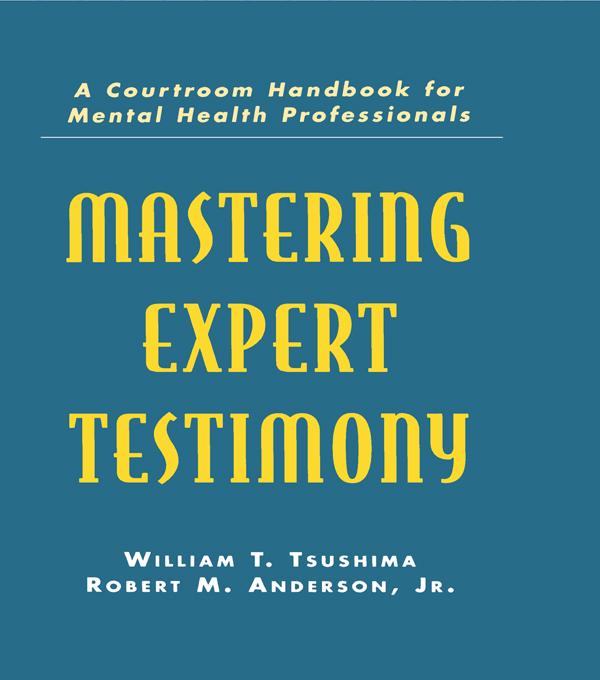
The past two decades have seen a rapidly growing involvement of psychologists and psychiatrists in legal proceedings for criminal cases, divorces, and traffic and industrial accidents. Mental health professionals are traditionally not trained to cope with the legal responsibilities that arise from their routine clinical work and are eager to learn the professional skills that are needed in forensic settings. There is presently no book which focuses entirely on the strategies and verbal tactics employed by attorneys who critically examine and challenge the testimony of mental health professionals. If psychologists and psychiatrists can familiarize themselves with the kind of questions and verbal exchanges that take place in the courtroom, they would be better prepared to provide their expertise in an effective manner. This book fills that need.
Designed as a practical handbook to assist practitioners from all mental health disciplines, it focuses on typical courtroom dialogue between attorneys and mental health professionals who testify regarding their psychotherapy clients and also those who are hired by attorneys specifically to provide expert opinions. The authors, who have extensive experience in the courtroom, offer well-thought-out, effective responses as contrasted with impulsive and weak answers to attorneys' queries. Actual cases are employed to illustrate typical challenges in various legal areas, including criminal law, child custody hearings, and personal injury cases. Certain forensic issues such as the scientific bases of expert opinions, the accuracy of psychological vs. medical tests, and malingering, are emphasized throughout the chapters.
The book is based on the belief that exposure to courtroom dialogue enhances the awareness of appropriate professional responses to an attorney's cross-examination and greatly alleviates fear toward a situation well-known to provoke intense levels of anxiety. Although it is written alluding to the forensic psychologist or psychiatrist, the strategies for the witness are readily applicable in most instances to all mental health professionals. Issues such as therapist bias, unconfirmed observations, and cultural and ethnic factors are clearly relevant to all who provide mental health services.
Betal nemt med kort, Klarna, Apple Pay eller Google Pay. Ikke tilfreds? Du har altid 14 dages fortrydelsesret. Læs mere i vores vilkår. Har du spørgsmål, så send os en mail på hello@memmo.org.
Memmo gør det nemmere at studere – uanset hvor du er i verden. Hos os samler du dine kursusbøger og smarte studieværktøjer ét sted: resuméer, quizzer, podcasts og flashcards. Og så er der Ted, din studieven, der svarer på alt, du undrer dig over. Over 50 000 studerende studerer allerede her – bygget til at hjælpe dig med at lære hurtigere og stresse mindre.