
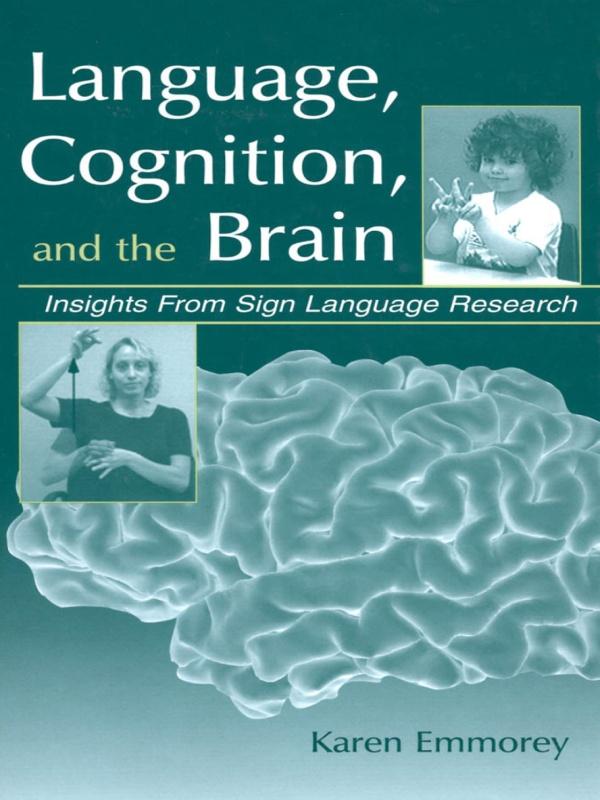
Once signed languages are recognized as natural human languages, a world of exploration opens up. Signed languages provide a powerful tool for investigating the nature of human language and language processing, the relation between cognition and language, and the neural organization of language. The value of sign languages lies in their modality. Specifically, for perception, signed languages depend upon high-level vision and motion processing systems, and for production, they require the integration of motor systems involving the hands and face. These facts raise many questions: What impact does this different biological base have for grammatical systems? For online language processing? For the acquisition of language? How does it affect nonlinguistic cognitive structures and processing? Are the same neural systems involved?
These are some of the questions that this book aims at addressing. The answers provide insight into what constrains grammatical form, language processing, linguistic working memory, and hemispheric specialization for language. The study of signed languages allows researchers to address questions about the nature of linguistic and cognitive systems that otherwise could not be easily addressed.
Betal nemt med kort, Klarna, Apple Pay eller Google Pay. Ikke tilfreds? Du har altid 14 dages fortrydelsesret. Læs mere i vores vilkår. Har du spørgsmål, så send os en mail på hello@memmo.org.
Memmo gør det nemmere at studere – uanset hvor du er i verden. Hos os samler du dine kursusbøger og smarte studieværktøjer ét sted: resuméer, quizzer, podcasts og flashcards. Og så er der Ted, din studieven, der svarer på alt, du undrer dig over. Over 50 000 studerende studerer allerede her – bygget til at hjælpe dig med at lære hurtigere og stresse mindre.