
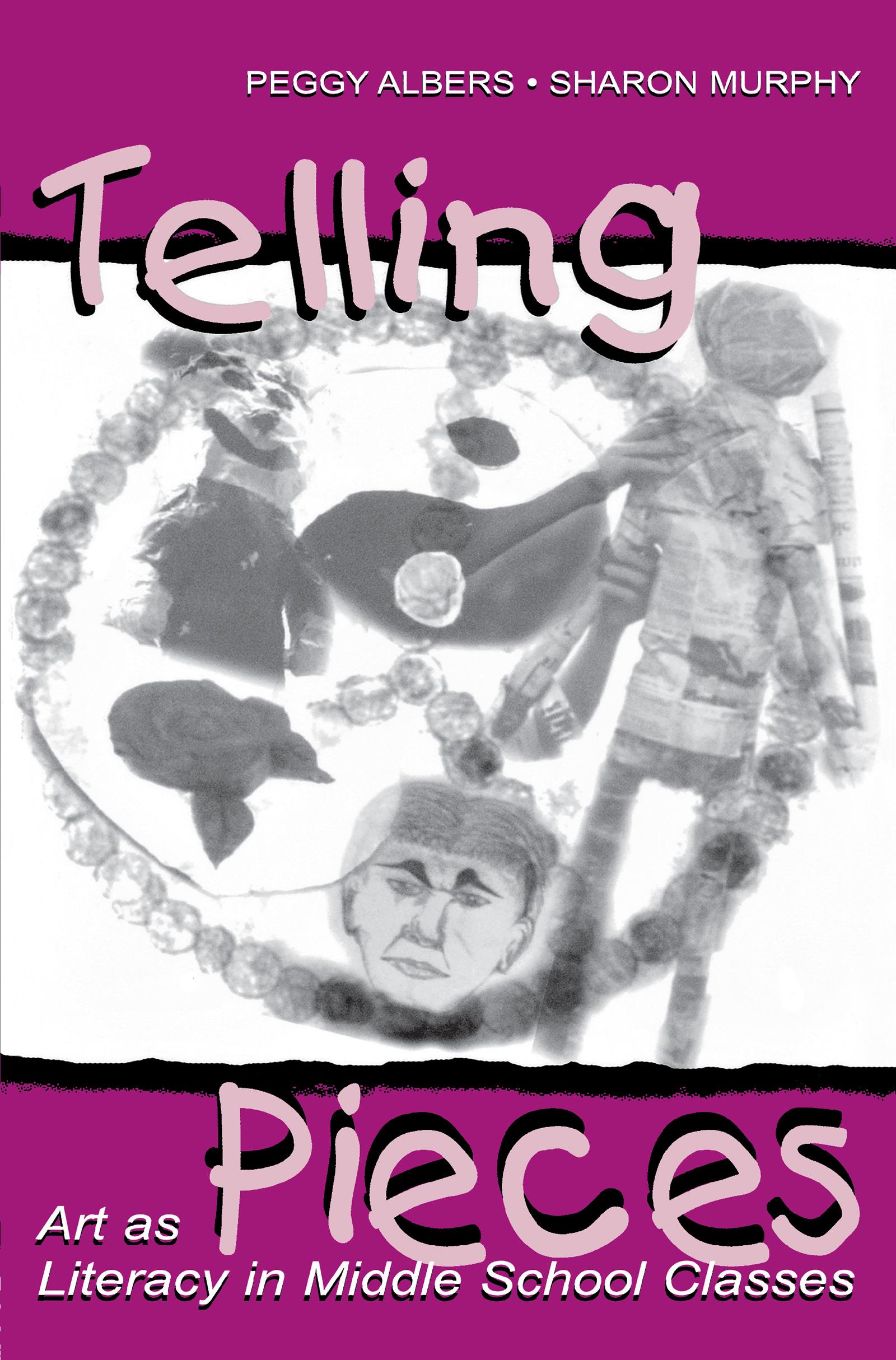
Telling Pieces is an exploration of how pre-adolescent middle-school children develop a knowledge and understanding of the conventions of art (art as literacy) and how they use this knowledge to create representations of their lives in a small midwestern U.S. town.
Beginning with an overview of social semiotics and emergent literacy theorizing, the authors set the stage for their study of sixth graders involved in art. A galleria of children's artworks is presented, allowing readers/viewers to consider these texts independent of the authors' interpretations of them. Then, set against the galleria is the story of the community and school contexts in which the artworks are produced--contexts in which racism, homophobia, and the repression of creativity are often the norm. The interpretation the authors bring to bear on the artworks reveals stories that the artworks may or may not tell on their own. But the tales of artistic literacy achievement are counterbalanced by reflection about the content of the artworks produced, because the artworks reveal the impossibility for students to imagine beyond the situational bounds of racism, homophobia, and religiosity. The authors conclude by raising questions about the kinds of conditions that make literacy in art possible. In doing so, they explore selected alternative models and, in addition, ask readers to consider the implications of the ideological issues underlying teaching children how to represent their ideas. They also advocate for a participatory pedagogy of possibility founded on ethical relational principles in the creation and interpretation of visual text.
Of particular interest to school professionals, researchers, and graduate students in literacy or art education, this pioneering book:
* brings together the fields of art education and literacy education through its focus on how middle school students come to work with and understand the semiotic systems,
* introduces sociolinguistic, sociological, and postmodernist perspectives to thinking about children's work with art--adding a new dimension to the psychological and developmental descriptions that have tended to dominate thinking in the field,
* includes a galleria of 40 examples of children's artwork, providing a unique opportunity for readers/viewers to interpret and consider the artwork of the sixth graders independent of the authors' interpretations,
* presents descriptions of art teaching in process,
* gives considerable attention to the interpretation of the children's artworks and the influences that contribute to the content they represent, and
* considers varying models of art education along with the implications of introducing new representational possibilities.
Betal nemt med kort, Klarna, Apple Pay eller Google Pay. Ikke tilfreds? Du har altid 14 dages fortrydelsesret. Læs mere i vores vilkår. Har du spørgsmål, så send os en mail på hello@memmo.org.
Memmo gør det nemmere at studere – uanset hvor du er i verden. Hos os samler du dine kursusbøger og smarte studieværktøjer ét sted: resuméer, quizzer, podcasts og flashcards. Og så er der Ted, din studieven, der svarer på alt, du undrer dig over. Over 50 000 studerende studerer allerede her – bygget til at hjælpe dig med at lære hurtigere og stresse mindre.