
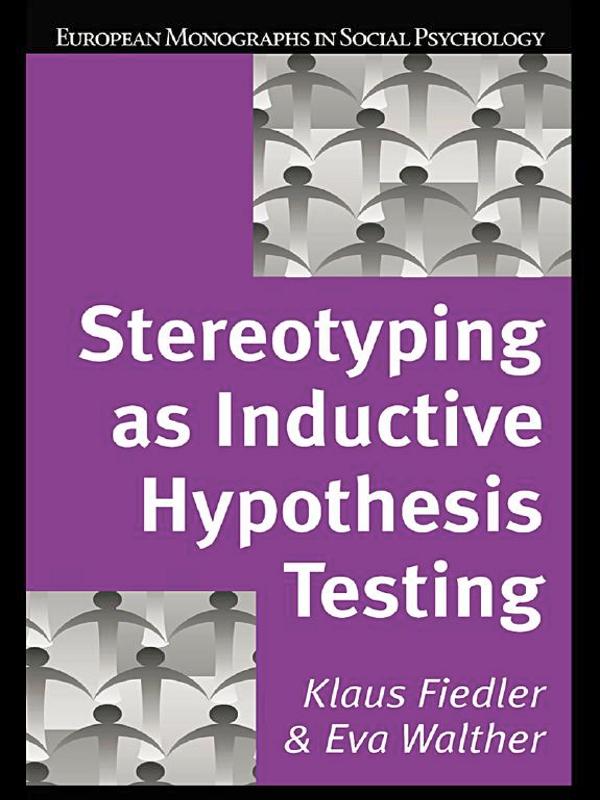
Traditional social hypotheses have a built-in tendency to verify themselves and so involuntarily resist attempts at stereotype change or correction. This is the insight demonstrated and discussed as the start point for an alternative approach to the problem of stereotyping and hypothesis testing. Stereotyping as Inductive Hypothesis Testing explicates the proposition that many stereotypes originate not so much in individual brains, but in the stimulus environment that interacts with and constitutes the social individual. This cognitive-ecological approach is then used to analyse the different aspects of language, sign systems and communication that can implicitly govern hypothesis testing procedures and lead to circular or reinforcing outcomes. The authors describe factors in tests such as judgment, memory and expectation and go on to suggest viable ecological learning approaches to them. An original research project based on a classroom situation is used to demonstrate and verify findings. The cognitive-ecological approach is then contextualised in relation to both the traditional approaches it can replace and the contemporary statistical sampling practices it can improve. Written with a profound understanding of the link between theoretical rigour and good empirical research practice this monograph will be invaluable to anyone with an interest in stereotyping or who wishes to enhance the reliability and self-awareness of their research methods.
Betal nemt med kort, Klarna, Apple Pay eller Google Pay. Ikke tilfreds? Du har altid 14 dages fortrydelsesret. Læs mere i vores vilkår. Har du spørgsmål, så send os en mail på hello@memmo.org.
Memmo gør det nemmere at studere – uanset hvor du er i verden. Hos os samler du dine kursusbøger og smarte studieværktøjer ét sted: resuméer, quizzer, podcasts og flashcards. Og så er der Ted, din studieven, der svarer på alt, du undrer dig over. Over 50 000 studerende studerer allerede her – bygget til at hjælpe dig med at lære hurtigere og stresse mindre.