
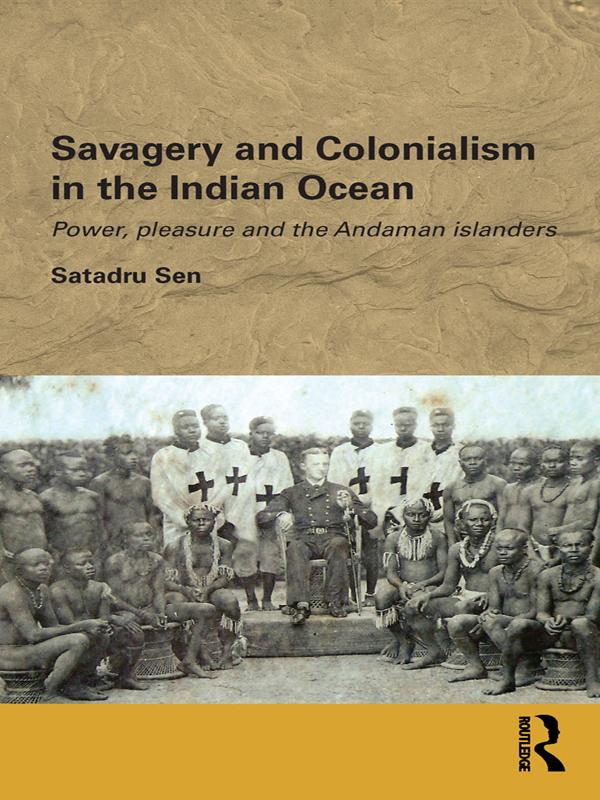
This book examines the social, political and ideological dimensions of the encounter between the indigenous inhabitants of the Andaman islands, British colonizers and Indian settlers in the eighteenth and nineteenth centuries. The British-Indian penal settlements in the Andaman Islands – beginning tentatively in 1789 and renewed on a larger scale in 1858 – represent an extensive, complex experiment in the management of populations through colonial discourses of race, criminality, civilization, and savagery. Focussing on the ubiquitous characterization of the Andaman islanders as ‘savages’, this study explores the particular relationship between savagery and the practice of colonialism.
Satadru Sen examines savagery and the savage as dynamic components of colonialism in South Asia: not intellectual abstractions with clear and fixed meanings, but politically ‘alive’ and fiercely contested products of the colony. Illuminating and historicizing the processes by which the discourse of savagery goes through multiple and fundamental shifts between the late eighteenth and late nineteenth centuries, he shows the links and breaks between these shifts and changing ideas of race, adulthood and masculinity in the Andamans, British India, Britain and in the wider empire. He also highlights the implications of these changes for the ‘savages’ themselves. At the broadest level, this book re-examines the relationship between the modern and the primitive in a colonial world.
Betal nemt med kort, Klarna, Apple Pay eller Google Pay. Ikke tilfreds? Du har altid 14 dages fortrydelsesret. Læs mere i vores vilkår. Har du spørgsmål, så send os en mail på hello@memmo.org.
Memmo gør det nemmere at studere – uanset hvor du er i verden. Hos os samler du dine kursusbøger og smarte studieværktøjer ét sted: resuméer, quizzer, podcasts og flashcards. Og så er der Ted, din studieven, der svarer på alt, du undrer dig over. Over 50 000 studerende studerer allerede her – bygget til at hjælpe dig med at lære hurtigere og stresse mindre.