
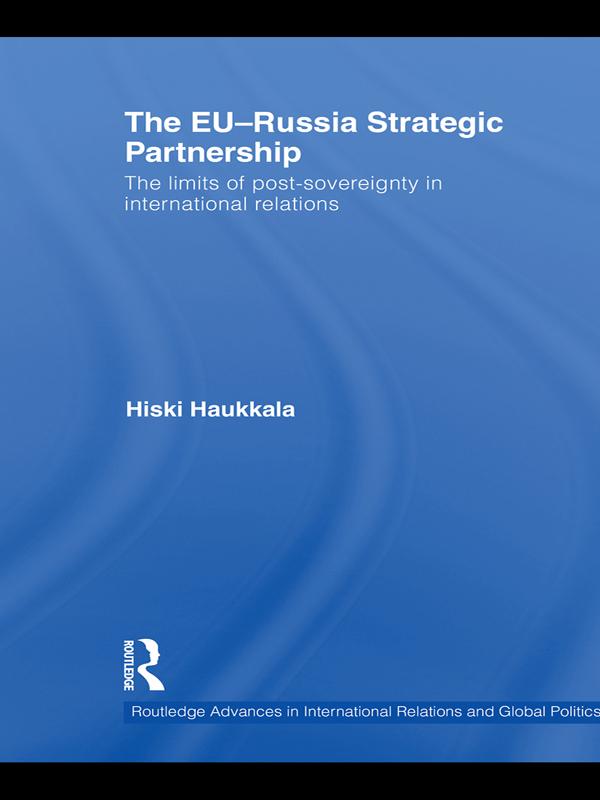
Why have the European Union and the Russian Federation encountered severe difficulties in developing their relationship? Why haven’t the parties lived up to the initial promise and enthusiasm of the early 1990s?
Beginning with the immediate aftermath of the dissolution of the Soviet Union, this book provides a practical answer to these questions whilst linking the issues to International Relations theorizing. Taking into account both the role of ideas and power, the book links the topic with three variants of mainstream theorizing: the English School, (neoliberal) institutionalism and constructivism. In the process a multi-causal framework that looks for points of convergence between different paradigms in the study of IR is developed.
Providing an overview, history and explanation of the problems of institutionalization in EU-Russia relations during the post-Cold War era, this book is vital reading for students and scholars of the EU and Russia, European studies, European security and Russian foreign policy. It will also be of major interest to scholars of International Relations theory.
Betal nemt med kort, Klarna, Apple Pay eller Google Pay. Ikke tilfreds? Du har altid 14 dages fortrydelsesret. Læs mere i vores vilkår. Har du spørgsmål, så send os en mail på hello@memmo.org.
Memmo gør det nemmere at studere – uanset hvor du er i verden. Hos os samler du dine kursusbøger og smarte studieværktøjer ét sted: resuméer, quizzer, podcasts og flashcards. Og så er der Ted, din studieven, der svarer på alt, du undrer dig over. Over 50 000 studerende studerer allerede her – bygget til at hjælpe dig med at lære hurtigere og stresse mindre.