
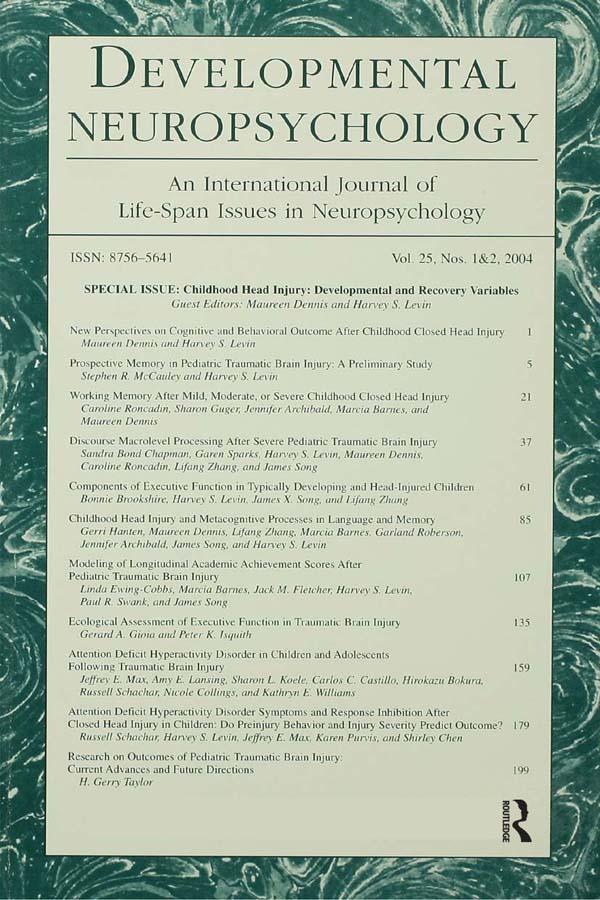
Childhood head injuries differ from adult head injuries in some significant respects. They occur against a background of ongoing physical and cognitive development. Cognitive capacities often change with time post-injury. But for children changes are affected by two processes of functional plasticity, one concerned with recovery, one with development. The impact of the injury is moderated by age/developmental stage.
In recent years there has been a new focus on the longitudinal comparison of children post-injury with appropriate control groups. Advances in neuropsychological assessment have permitted evaluation with reference to more developmentally suitable norms; expanded definitions of outcome have broadened our understanding of consequences; and neuroimaging techniques have enabled the more precise delineation of injury severity, the study of structure-function outcome relations, and the investigation of reorganization of function.
This special issue offers an overview of cutting-edge approaches to the analysis of childhood head injury.
Betal nemt med kort, Klarna, Apple Pay eller Google Pay. Ikke tilfreds? Du har altid 14 dages fortrydelsesret. Læs mere i vores vilkår. Har du spørgsmål, så send os en mail på hello@memmo.org.
Memmo gør det nemmere at studere – uanset hvor du er i verden. Hos os samler du dine kursusbøger og smarte studieværktøjer ét sted: resuméer, quizzer, podcasts og flashcards. Og så er der Ted, din studieven, der svarer på alt, du undrer dig over. Over 50 000 studerende studerer allerede her – bygget til at hjælpe dig med at lære hurtigere og stresse mindre.