
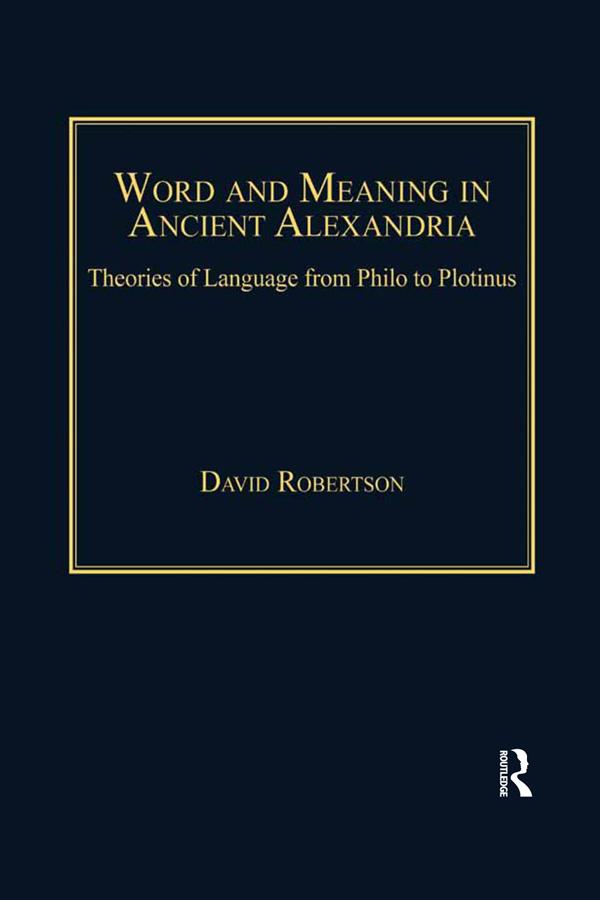
During the late Hellenistic and early Imperial periods (B.C. 50 - A.D. 300), important developments may be traced in the philosophy of language and its relationship to mind. This book examines theories of language in the work of theologians and philosophers linked to Ancient Alexandria. The growth of Judaism and Christianity in cultural centers of the Roman Empire, above all Alexandria, provides valuable testimony to the philosophical vitality of this period. The study of Later Greek philosophy should be more closely integrated with the Church Fathers, particularly in the theologically sensitive issue of the nature of language. Robertson traces some related attempts to reconcile immaterial, intelligible reality and the intelligibility of language, explain the structure of language, and clarify the nature of meaning. These shared problems are handled with greater philosophical sophistication by Plotinus, although the comparison with Philo, Clement, and Origen illustrates significant similarities as well as differences between Neoplatonism and early Jewish and Christian philosophy.
Betal nemt med kort, Klarna, Apple Pay eller Google Pay. Ikke tilfreds? Du har altid 14 dages fortrydelsesret. Læs mere i vores vilkår. Har du spørgsmål, så send os en mail på hello@memmo.org.
Memmo gør det nemmere at studere – uanset hvor du er i verden. Hos os samler du dine kursusbøger og smarte studieværktøjer ét sted: resuméer, quizzer, podcasts og flashcards. Og så er der Ted, din studieven, der svarer på alt, du undrer dig over. Over 50 000 studerende studerer allerede her – bygget til at hjælpe dig med at lære hurtigere og stresse mindre.
Du kan måske også lide
Køb bogen0