
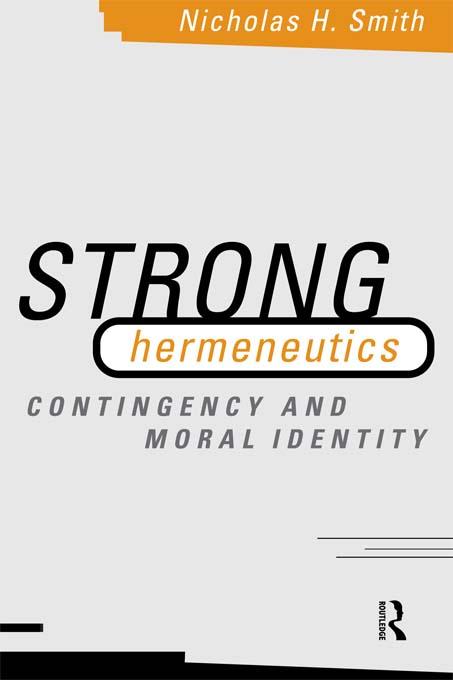
Recent years have seen a resurgence of interest in ethics, particularly in the approaches of deconstruction and hermeneutics. At the same time, questions of identity have risen to prominence in philosophy and beyond into cultural studies and literature.
Strong Hermeneutics is a clear and accessible investigation of both the enlightenment and postmodern or 'weak' approaches to contemporary discussions of ethics. The weak view, which can be traced back to Nietzche and seen in the recent work of Rorty and Lyotard, is sceptical of any universal principles in ethics. The enlightenment view, starting with Kant and more recently seen in the work of Habermas, views identity as subject to universal but formal moral constraints, the renewing of which is the proper task of ethics.
Nicholas Smith argues that neither of these views can provide a proper framework for ethics. He puts forward a third position - a strong hermeneutics - drawing on the work of Hans-Georg Gadamer, Paul Ricoeur and Charles Taylor. Strong Hermeneutics presents a defence of this view, compares it with the realism and anti-realism debate in philosophy, and demonstrates its relevance to contemporary issues, particularly ecological responsibility.
Betal nemt med kort, Klarna, Apple Pay eller Google Pay. Ikke tilfreds? Du har altid 14 dages fortrydelsesret. Læs mere i vores vilkår. Har du spørgsmål, så send os en mail på hello@memmo.org.
Memmo gør det nemmere at studere – uanset hvor du er i verden. Hos os samler du dine kursusbøger og smarte studieværktøjer ét sted: resuméer, quizzer, podcasts og flashcards. Og så er der Ted, din studieven, der svarer på alt, du undrer dig over. Over 50 000 studerende studerer allerede her – bygget til at hjælpe dig med at lære hurtigere og stresse mindre.