
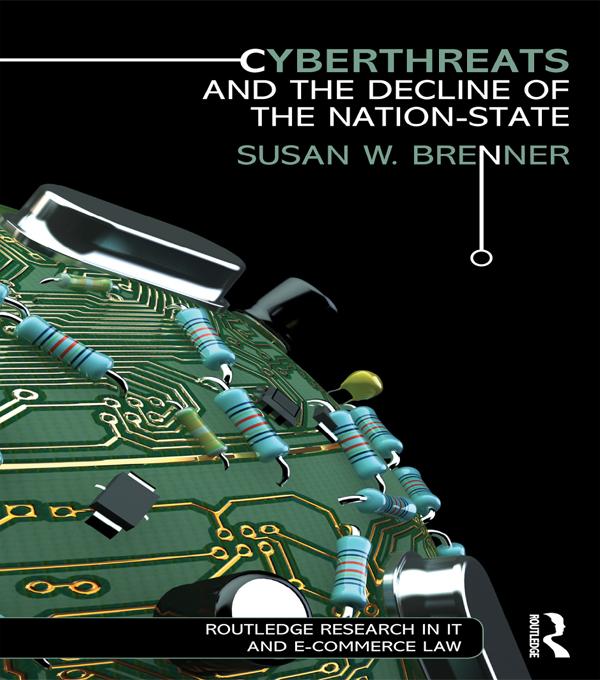
This book explores the extraordinary difficulties a nation-state’s law enforcement and military face in attempting to prevent cyber-attacks. In the wake of recent assaults including the denial of service attack on Estonia in 2007 and the widespread use of the Zeus Trojan Horse software, Susan W. Brenner explores how traditional categories and procedures inherent in law enforcement and military agencies can obstruct efforts to respond to cyberthreats. Brenner argues that the use of a territorially-based system of sovereignty to combat cyberthreats is ineffective, as cyberspace erodes the import of territory. This problem is compounded by the nature of cybercrime as a continually evolving phenomenon driven by rapid and complex technological change.
Following an evaluation of the efficacy of the nation-state, the book goes on to explore how individuals and corporations could be integrated into a more decentralized, distributed system of cyberthreat control. Looking at initiatives in Estonia and Sweden which have attempted to incorporate civilians into their cyber-response efforts, Brenner suggests that civilian involvement may mediate the rigid hierarchies that exist among formal agencies and increase the flexibility of any response. This book will be of great interest to students and researchers of information technological law and security studies.
Betal nemt med kort, Klarna, Apple Pay eller Google Pay. Ikke tilfreds? Du har altid 14 dages fortrydelsesret. Læs mere i vores vilkår. Har du spørgsmål, så send os en mail på hello@memmo.org.
Memmo gør det nemmere at studere – uanset hvor du er i verden. Hos os samler du dine kursusbøger og smarte studieværktøjer ét sted: resuméer, quizzer, podcasts og flashcards. Og så er der Ted, din studieven, der svarer på alt, du undrer dig over. Over 50 000 studerende studerer allerede her – bygget til at hjælpe dig med at lære hurtigere og stresse mindre.