
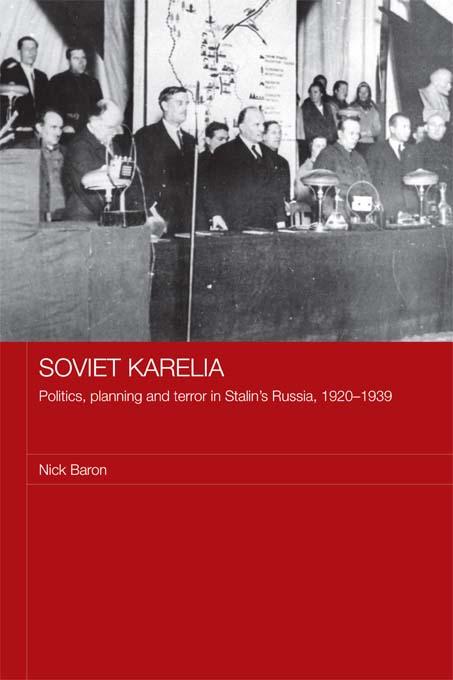
In 1920, Lenin authorised a plan to transform Karelia, a Russian territory adjacent to Finland, into a showcase Soviet autonomous region, to show what could be achieved by socialist nationalities policy and economic planning, and to encourage other countries to follow this example. However, Stalin’s accession to power brought a change of policy towards the periphery - the encouragement of local autonomy which had been a key part of Karelia’s model development was reversed, the state border was sealed to the outside world, and large parts of the republic's territory were given over to Gulag labour camps controlled by the NKVD, the precursor of the KGB. This book traces the evolution of Soviet Karelia in the early Soviet period, discussing amongst other things how political relations between Moscow and the regional leadership changed over time; the nature of its spatial, economic and demographic development; and the origins of the massive repressions launched in 1937 against the local population.
Betal nemt med kort, Klarna, Apple Pay eller Google Pay. Ikke tilfreds? Du har altid 14 dages fortrydelsesret. Læs mere i vores vilkår. Har du spørgsmål, så send os en mail på hello@memmo.org.
Memmo gør det nemmere at studere – uanset hvor du er i verden. Hos os samler du dine kursusbøger og smarte studieværktøjer ét sted: resuméer, quizzer, podcasts og flashcards. Og så er der Ted, din studieven, der svarer på alt, du undrer dig over. Over 50 000 studerende studerer allerede her – bygget til at hjælpe dig med at lære hurtigere og stresse mindre.