
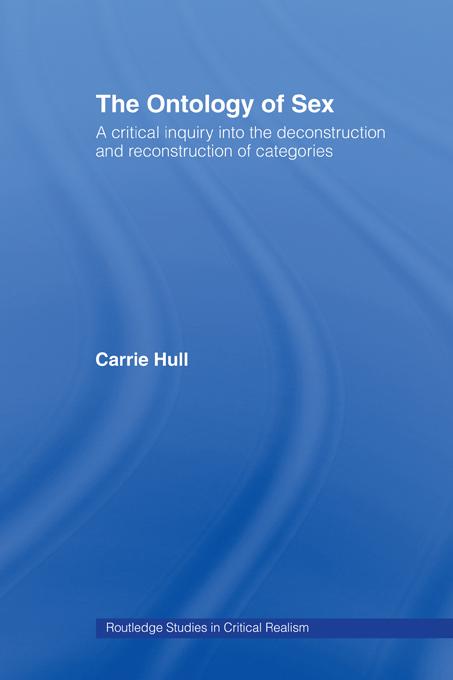
Poststructuralism, particularly through the writings of Michel Foucault and Judith Butler, has achieved remarkable success in challenging our belief in natural sex categories and instincts. Here, Carrie Hull endorses the progressive ideals of poststructuralism while demonstrating the superiority of a realist account of sex and sexuality. Embracing biological and cultural variability, Hull nonetheless shows that the sexed body is naturally structured and deeply meaningful.
Poststructuralist philosophers have argued that biological sex is a continuum rather than a binary, and that sex identity and drive are entirely performances of cultural norms rather than expressions of innate qualities. Hull draws parallels with Nelson Goodman, W.V.O. Quine, and B.F. Skinner to show that these poststructuralist theories are rooted in a nominalist, relativist, and behaviourist philosophy, and develops an alternative framework using arguments from contemporary and critical realism.
Employing colourful illustrations from biology, anthropology and psychology, Hull demonstrates the rich potential of realist philosophy, and concludes that it is philosophically and scientifically correct, on one hand, and politically advisable, on the other, to maintain a distinction - albeit attenuated - between sex and gender, and sexuality and behaviour.
Betal nemt med kort, Klarna, Apple Pay eller Google Pay. Ikke tilfreds? Du har altid 14 dages fortrydelsesret. Læs mere i vores vilkår. Har du spørgsmål, så send os en mail på hello@memmo.org.
Memmo gør det nemmere at studere – uanset hvor du er i verden. Hos os samler du dine kursusbøger og smarte studieværktøjer ét sted: resuméer, quizzer, podcasts og flashcards. Og så er der Ted, din studieven, der svarer på alt, du undrer dig over. Over 50 000 studerende studerer allerede her – bygget til at hjælpe dig med at lære hurtigere og stresse mindre.