
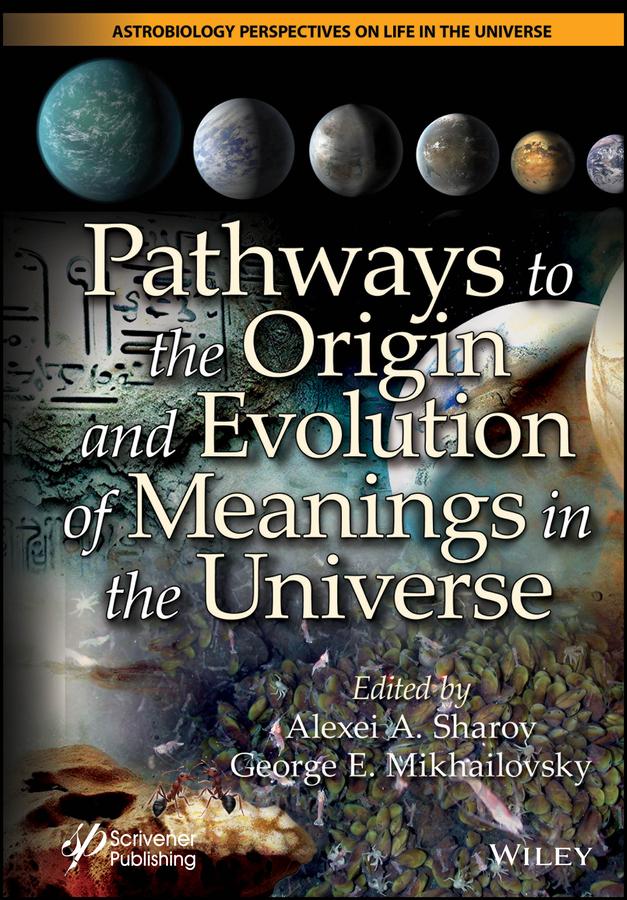
The book explains why meaning is a part of the universe populated by life, and how organisms generate meanings and then use them for creative transformation of the environment and themselves.
This book focuses on interdisciplinary research at the intersection of biology, semiotics, philosophy, ethology, information theory, and the theory of evolution. Such a broad approach provides a rich context for the study of organisms and other semiotic agents in their environments. This methodology can be applied to robotics and artificial intelligence for developing robust, adaptable learning devices.
In this book, leading interdisciplinary scholars reveal their vision on how to integrate natural sciences with semiotics, a theory of meaning-making and signification. Developments in biology indicate that the capacity to create and understand signs is not limited to humans or vertebrate animals, but exists in all living organisms - the fact that inspired the integration of biology and semiotics into biosemiotics. The authors discuss the nature of semiotic agents (organisms and other autonomous goal-directed units), meaning, signs, information, memory, evolution, and consciousness. Also discussed are issues including the origin of life, potential meaning and its actualization, top-down causality in physics and biology, capacity of organisms to encode their functions, the strategy of organisms to combine homeostasis with direct adaptation to new life-cycle phases or new environments, multi-level memory systems, increase of freedom via enabling constraints, creative modeling in evolution and learning, communication in animals and humans, the origin and function of language, and the distribution and transfer of life in space.
This is the first book on biosemiotics in its global conceptual and spatial scope. Biosemiotics is presented using the language of natural sciences, which supports the scientific grounding of semiotic terms. Finally, the cosmic dimension of life and meaning-making leads to a reconsideration of ethical principles and ecological mentality here on earth and in space exploration.
Audience
Theoretical biologists, ethologists, astrobiologists, ecologists, evolutionary biologists, philosophers, phenomenologists, semioticians, biosemioticians, molecular biologists, linguists, system scientists and engineers.
Betal nemt med kort, Klarna, Apple Pay eller Google Pay. Ikke tilfreds? Du har altid 14 dages fortrydelsesret. Læs mere i vores vilkår. Har du spørgsmål, så send os en mail på hello@memmo.org.
Memmo gør det nemmere at studere – uanset hvor du er i verden. Hos os samler du dine kursusbøger og smarte studieværktøjer ét sted: resuméer, quizzer, podcasts og flashcards. Og så er der Ted, din studieven, der svarer på alt, du undrer dig over. Over 50 000 studerende studerer allerede her – bygget til at hjælpe dig med at lære hurtigere og stresse mindre.