
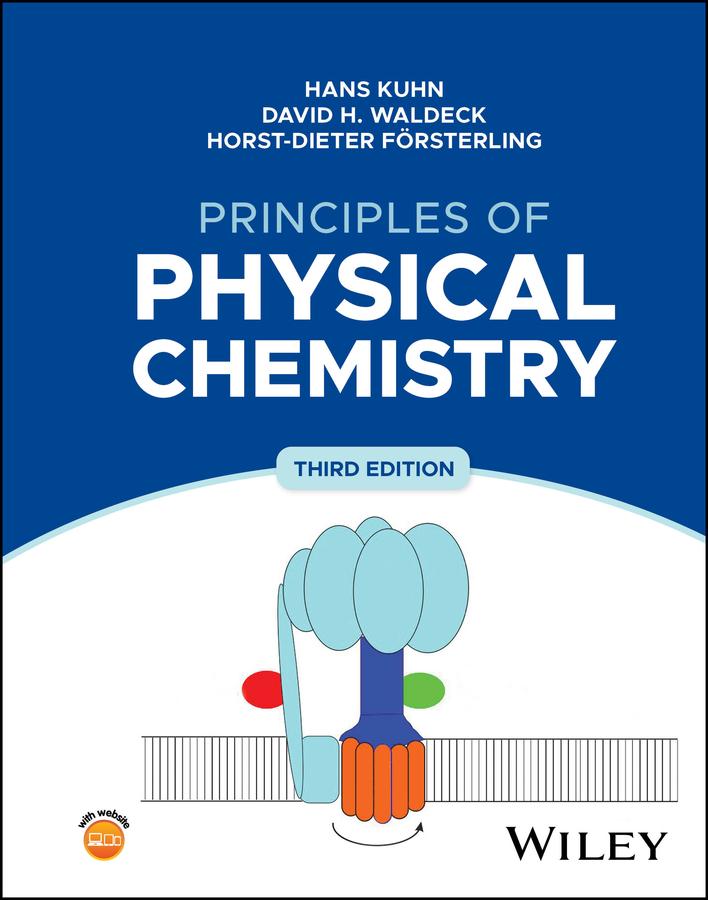
Core textbook showcasing the broad scope and coherence of physical chemistry
Principles of Physical Chemistry introduces undergraduate students to the concepts and methods of physical chemistry, which are fundamental to all of Chemistry. In their unique approach, the authors guide students along a logically consistent pathway from the principles of quantum mechanics and molecular structure to the properties of ensembles and supramolecular machines, with many examples from biology and nanoscience. By systematically proceeding from atoms to increasingly complex forms of matter, the book elucidates the connection between recognizable paradigms and modern chemistry research in a student-friendly manner. To promote intuition and understanding for beginning students, the text introduces concepts before proceeding to more rigorous treatments. Rigorous proofs and derivations are provided, as electronic supplements, for more advanced students.
The book poses over 900 exercises and problems to help the student learn and master methods for physicochemical reasoning. Computational supplementary material, including Fortran simulations, MathCAD exercises, and Mathematica programs, are included on a companion website.
Some topics discussed in the text are:
- Electronic structure and Variational Principle, including Pauli exclusion, spin-orbit interactions, and electron confinement in quantum dots.
- Chemical bonding and molecular structure, including electron tunneling, comparison of electron-in-a-box models and electron orbital methods, and the mechanics of chemical bonds.
- Absorption and emission of light, including transition dipoles for π-electron systems, coupled chromophores, excitons, and chiroptical activity.
- Statistical description of molecular ensembles, including microscopic interpretations of phase transitions, entropy, work, and heat.
- Chemical equilibria, including statistical description of equilibrium constants, electrochemistry, and the exposition of fundamental reaction types.
- Reaction kinetics and reaction dynamics, including nonlinear coupled reactions, femtochemistry, and solvent effects on reactions.
- Physicochemical properties of macromolecules and the principles of supramolecular assemblies, including polymer dynamics and chemical control of interfaces.
- The logic of supramolecular machines and their manipulation of photon, electron, and nuclear motion.
With its highly coherent and systematic approach to the subject, Principles of Physical Chemistry is an ideal textbook and resource for students in undergraduate physical chemistry courses, especially those in programs of study related to chemistry, engineering, and molecular and chemical biology.
Betal nemt med kort, Klarna, Apple Pay eller Google Pay. Ikke tilfreds? Du har altid 14 dages fortrydelsesret. Læs mere i vores vilkår. Har du spørgsmål, så send os en mail på hello@memmo.org.
Memmo gør det nemmere at studere – uanset hvor du er i verden. Hos os samler du dine kursusbøger og smarte studieværktøjer ét sted: resuméer, quizzer, podcasts og flashcards. Og så er der Ted, din studieven, der svarer på alt, du undrer dig over. Over 50 000 studerende studerer allerede her – bygget til at hjælpe dig med at lære hurtigere og stresse mindre.