
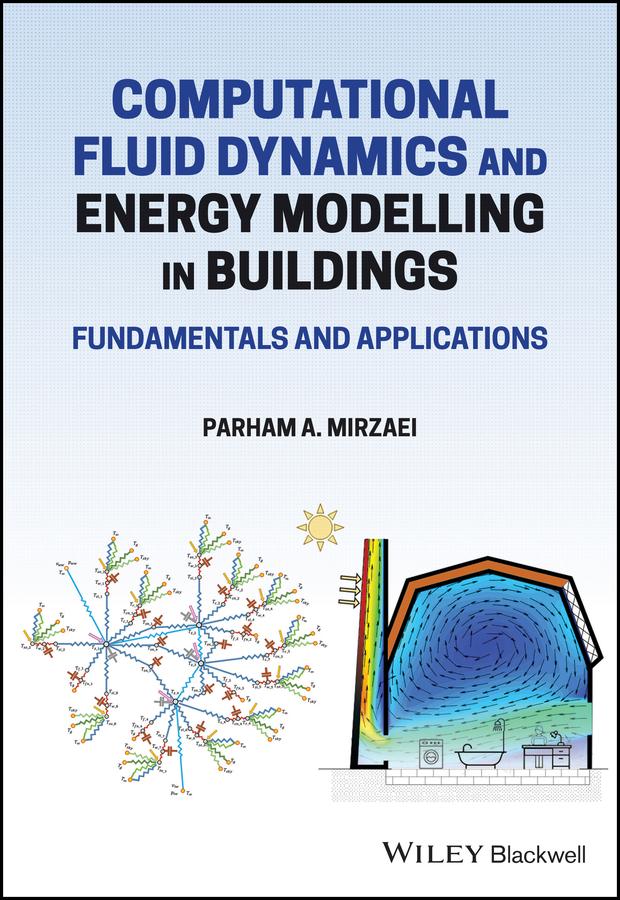
A Comprehensive Overview of the Fundamentals of Heat and Mass Transport Simulation and Energy Performance in Buildings
In the first part of Computational Fluid Dynamics and Energy Modelling in Buildings: Fundamentals and Applications, the author explains the fundamentals of fluid mechanics, thermodynamics, and heat transfer, with a specific focus on their application in buildings. This background knowledge sets the scene to further model heat and mass transport in buildings, with explanations of commonly applied simplifications and assumptions.
In the second part, the author elaborates how the fundamentals explained in part 1 can be used to model energy flow in buildings, which is the basis of all commercial and educational building energy simulation tools. An innovative illustrative nodal network concept is introduced to help readers comprehend the basics of conservation laws in buildings. The application of numerical techniques to form dynamic simulation tools are then introduced. In general, understanding these techniques will help readers to identify and justify their choices when working with building energy simulation tools, rather than using default settings.
Detailed airflow information in buildings cannot be obtained in building energy simulation techniques. Therefore, part three is focused on introducing computational fluid dynamics (CFD) as a detailed modelling technique for airflow in buildings. This part starts with an introduction to the fundamentals of the finite volume method used to solve the governing fluid equations and the related challenges and considerations are discussed. The last chapter of this part covers the solutions to some practical problems of airflow within and around buildings.
The key aspect of Computational Fluid Dynamics and Energy Modelling in Buildings: Fundamentals and Applications is that it is tailored for audiences without extensive past experience of numerical methods. Undergraduate or graduate students in architecture, urban planning, geography, architectural engineering, and other engineering fields, along with building performance and simulation professionals, can use this book to gain additional clarity on the topics of building energy simulation and computational fluid dynamics.
Betal nemt med kort, Klarna, Apple Pay eller Google Pay. Ikke tilfreds? Du har altid 14 dages fortrydelsesret. Læs mere i vores vilkår. Har du spørgsmål, så send os en mail på hello@memmo.org.
Memmo gør det nemmere at studere – uanset hvor du er i verden. Hos os samler du dine kursusbøger og smarte studieværktøjer ét sted: resuméer, quizzer, podcasts og flashcards. Og så er der Ted, din studieven, der svarer på alt, du undrer dig over. Over 50 000 studerende studerer allerede her – bygget til at hjælpe dig med at lære hurtigere og stresse mindre.