
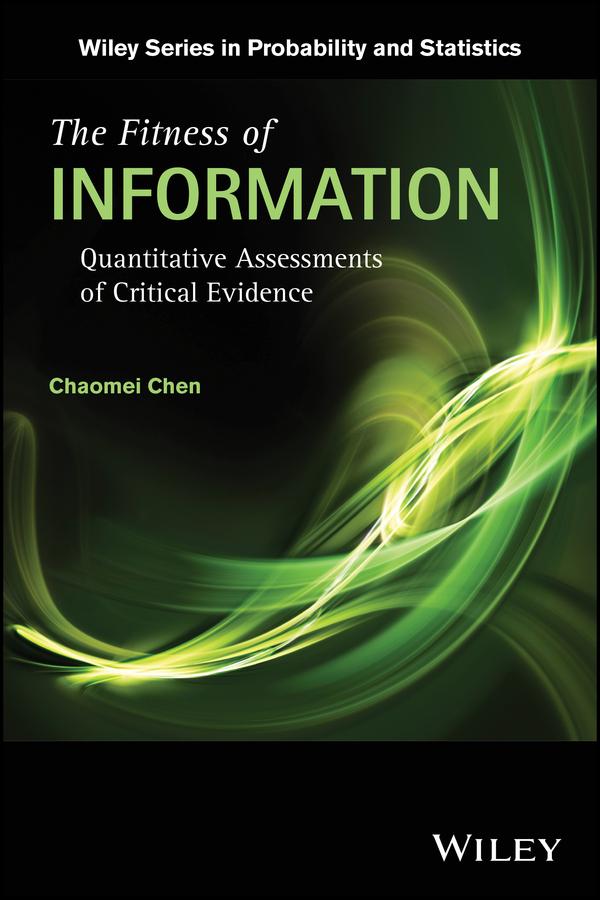
Theories and practices to assess critical information in a complex adaptive system
Organized for readers to follow along easily, The Fitness of Information: Quantitative Assessments of Critical Evidence provides a structured outline of the key challenges in assessing crucial information in a complex adaptive system. Illustrating a variety of computational and explanatory challenges, the book demonstrates principles and practical implications of exploring and assessing the fitness of information in an extensible framework of adaptive landscapes.
The book’s first three chapters introduce fundamental principles and practical examples in connection to the nature of aesthetics, mental models, and the subjectivity of evidence. In particular, the underlying question is how these issues can be addressed quantitatively, not only computationally but also explanatorily. The next chapter illustrates how one can reduce the level of complexity in understanding the structure and dynamics of scientific knowledge through the design and use of the CiteSpace system for visualizing and analyzing emerging trends in scientific literature. The following two chapters explain the concepts of structural variation and the fitness of information in a framework that builds on the idea of fitness landscape originally introduced to study population evolution. The final chapter presents a dual-map overlay technique and demonstrates how it supports a variety of analytic tasks for a new type of portfolio analysis.
The Fitness of Information: Quantitative Assessments of Critical Evidence also features:
- In-depth case studies and examples that characterize far-reaching concepts, illustrate underlying principles, and demonstrate profound challenges and complexities at various levels of analytic reasoning
- Wide-ranging topics that underline the common theme, from the subjectivity of evidence in criminal trials to detecting early signs of critical transitions and mechanisms behind radical patents
- An extensible and unifying framework for visual analytics by transforming analytic reasoning tasks to the assessment of critical evidence
The Fitness of Information: Quantitative Assessments of Critical Evidence is a suitable reference for researchers, analysts, and practitioners who are interested in analyzing evidence and making decisions with incomplete, uncertain, and even conflicting information. The book is also an excellent textbook for upper-undergraduate and graduate-level courses on visual analytics, information visualization, and business analytics and decision support systems.
Betal nemt med kort, Klarna, Apple Pay eller Google Pay. Ikke tilfreds? Du har altid 14 dages fortrydelsesret. Læs mere i vores vilkår. Har du spørgsmål, så send os en mail på hello@memmo.org.
Memmo gør det nemmere at studere – uanset hvor du er i verden. Hos os samler du dine kursusbøger og smarte studieværktøjer ét sted: resuméer, quizzer, podcasts og flashcards. Og så er der Ted, din studieven, der svarer på alt, du undrer dig over. Over 50 000 studerende studerer allerede her – bygget til at hjælpe dig med at lære hurtigere og stresse mindre.