
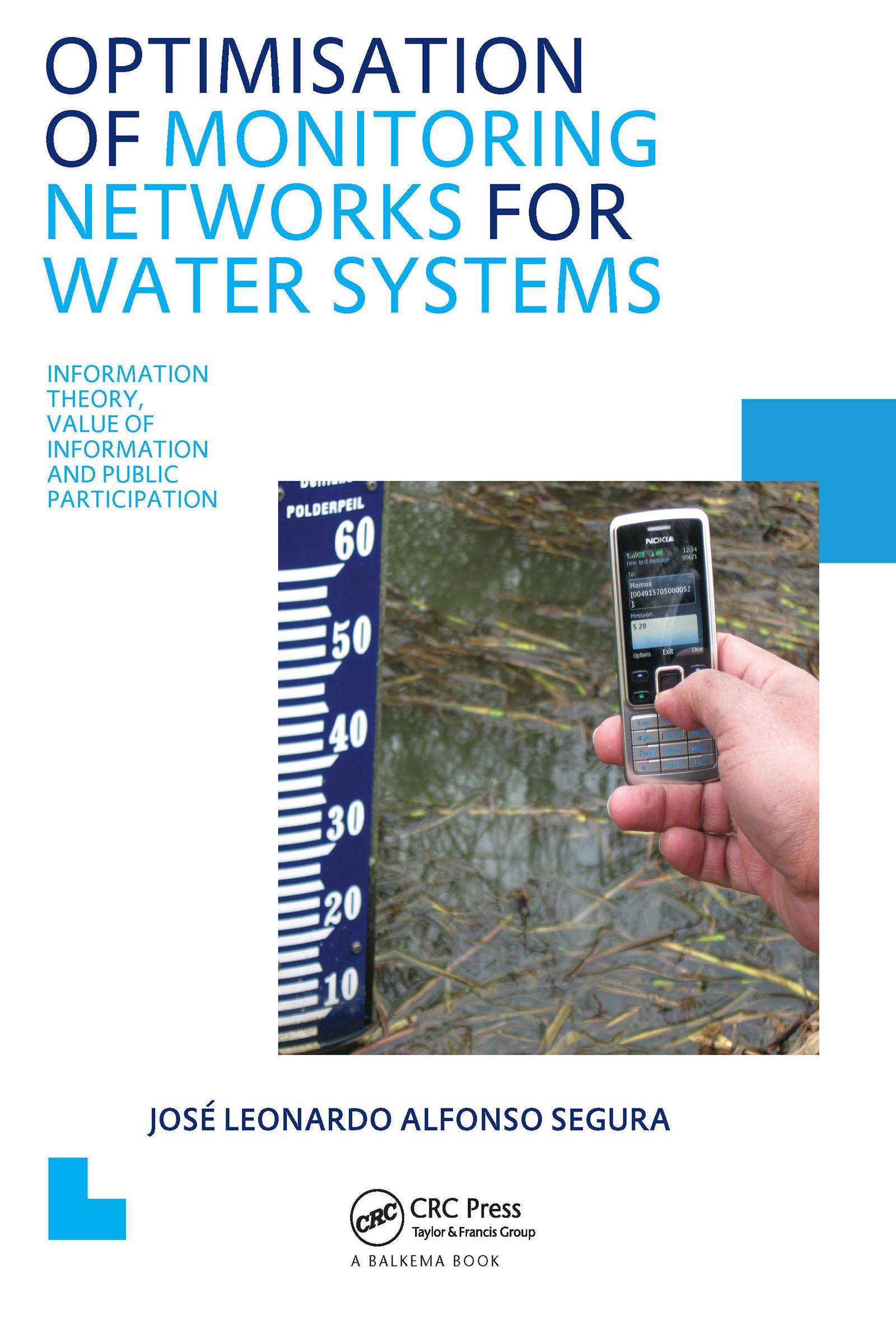
Monitoring networks provide data that is analysed to help managers make informed decisions about their water systems. Their design and evaluation have a number of challenges that must be resolved, among others, the restriction on having a limited number of monitoring devices.
This book presents innovative methods to design and evaluate monitoring networks. The main idea is to maximise the performance of water systems by optimising the information content that can be obtained from monitoring networks. This is done through the combination of models and two theoretical concepts: Information Theory, initially developed in the field of communications, and Value of Information, initially developed in the field of economics. Additionally, the possibility of using public participation to gather information with mobile phones to improve models is also explored in the research. Two very different case studies are used to test the developed methods and theories: Pijnacker, a typical low-lying regional polder in the Netherlands, which is highly controlled and the Magdalena River, the major river system in Colombia.
The results of this research demonstrate that monitoring networks can be evaluated and designed by considering new variables, such as the information content, the user of the information and the potential of current mobile phones for data collection.
Betal nemt med kort, Klarna, Apple Pay eller Google Pay. Ikke tilfreds? Du har altid 14 dages fortrydelsesret. Læs mere i vores vilkår. Har du spørgsmål, så send os en mail på hello@memmo.org.
Memmo gør det nemmere at studere – uanset hvor du er i verden. Hos os samler du dine kursusbøger og smarte studieværktøjer ét sted: resuméer, quizzer, podcasts og flashcards. Og så er der Ted, din studieven, der svarer på alt, du undrer dig over. Over 50 000 studerende studerer allerede her – bygget til at hjælpe dig med at lære hurtigere og stresse mindre.