
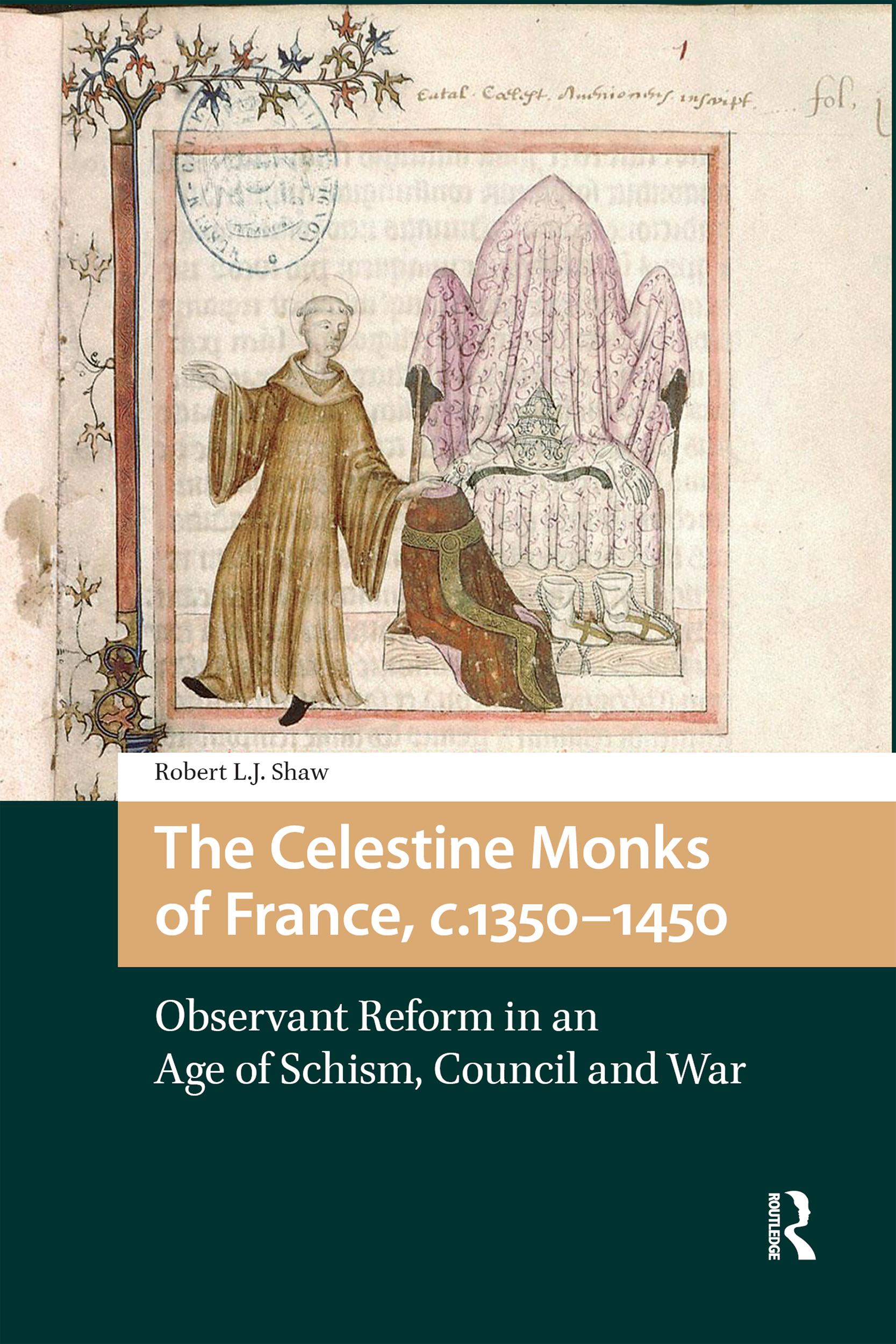
The Celestine monks of France represent one of the least studied monastic reform movements of the late Middle Ages, and yet also one of the most culturally impactful. Their order - an austere Italian Benedictine reform of the late thirteenth century, which came be known after the papal name of their founder, Celestine V (St Peter of Murrone) - arrived in France in 1300. After a period of marginal growth, they flourished in the region from the mid-fourteenth century, founding thirteen new houses over the next hundred years, taking their total to seventeen by 1450. Not only did the French Celestines expand, they gained a distinctive character that separated them from their Italian brothers. More urban, better connected with both aristocratic and bourgeois society, and yet still rigorous and reformist, they characterised themselves as the 'Observant' wing of their order, having gained self-government for their provincial congregation in 1380 following the arrival of the Great Western Schism (1378-1417). But, as Robert L.J. Shaw argues, their importance runs beyond monastic reform: the late medieval French Celestines are a mirror of the political, intellectual, and Christian reform culture of their age. Within a France torn by war and a Church divided by schism, the French Celestines represented hope for renewal, influencing royal presentation, lay religion, and some of the leading French intellectuals of the period, including Jean Gerson.
Betal nemt med kort, Klarna, Apple Pay eller Google Pay. Ikke tilfreds? Du har altid 14 dages fortrydelsesret. Læs mere i vores vilkår. Har du spørgsmål, så send os en mail på hello@memmo.org.
Memmo gør det nemmere at studere – uanset hvor du er i verden. Hos os samler du dine kursusbøger og smarte studieværktøjer ét sted: resuméer, quizzer, podcasts og flashcards. Og så er der Ted, din studieven, der svarer på alt, du undrer dig over. Over 50 000 studerende studerer allerede her – bygget til at hjælpe dig med at lære hurtigere og stresse mindre.
Du kan måske også lide
Køb bogen0