
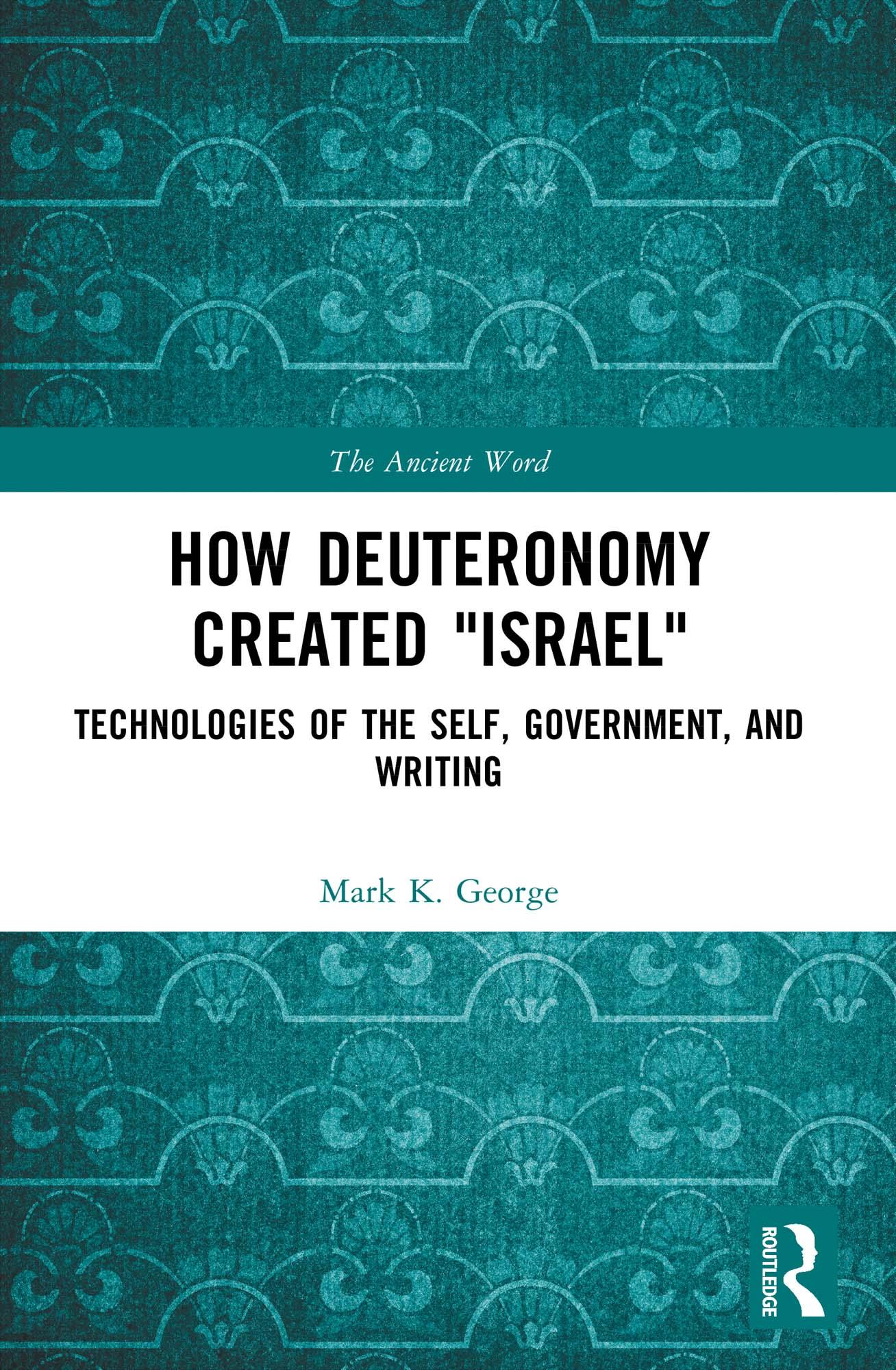
In this book, Mark K. George argues that the goal of Deuteronomy is not merely to provide ancient Judah with another set of laws but to write “Israel” itself into existence. He reads Deuteronomy as a manual for self‑definition with two key aspects: being an Israelite means recognizing oneself as a subject under Yahweh’s control, and Deuteronomy is the handbook of techniques by which one monitors oneself to become Israel.
Scholars have acknowledged the influence of certain literary features of ancient Assyrian imperial treaties on Deuteronomy. In this book, George argues that the key to both Deuteronomy and Assyrian rituals of control is their monitoring mechanism, not only speaking to their audiences but also providing them with new ways to understand themselves and behave. He suggests that Deuteronomy redefines not only Israel but also Yahweh himself according to an Assyrian imperial model—with Israel as the subject, God as a distant imperial ruler, and the text itself as a local monitor. In showing this, he extends the insights of Michel Foucault, who urged us to view power not merely as something imposed from above by force, but as something that can entwine and shape us from below.
This book provides an invaluable exploration of Deuteronomy, of interest to scholars and students working on Deuteronomy itself and biblical studies more generally, as well as on questions of ancient politics and governmentality, Foucault studies, and the history and material culture of the Ancient Near East.
Betal nemt med kort, Klarna, Apple Pay eller Google Pay. Ikke tilfreds? Du har altid 14 dages fortrydelsesret. Læs mere i vores vilkår. Har du spørgsmål, så send os en mail på hello@memmo.org.
Memmo gør det nemmere at studere – uanset hvor du er i verden. Hos os samler du dine kursusbøger og smarte studieværktøjer ét sted: resuméer, quizzer, podcasts og flashcards. Og så er der Ted, din studieven, der svarer på alt, du undrer dig over. Over 50 000 studerende studerer allerede her – bygget til at hjælpe dig med at lære hurtigere og stresse mindre.