
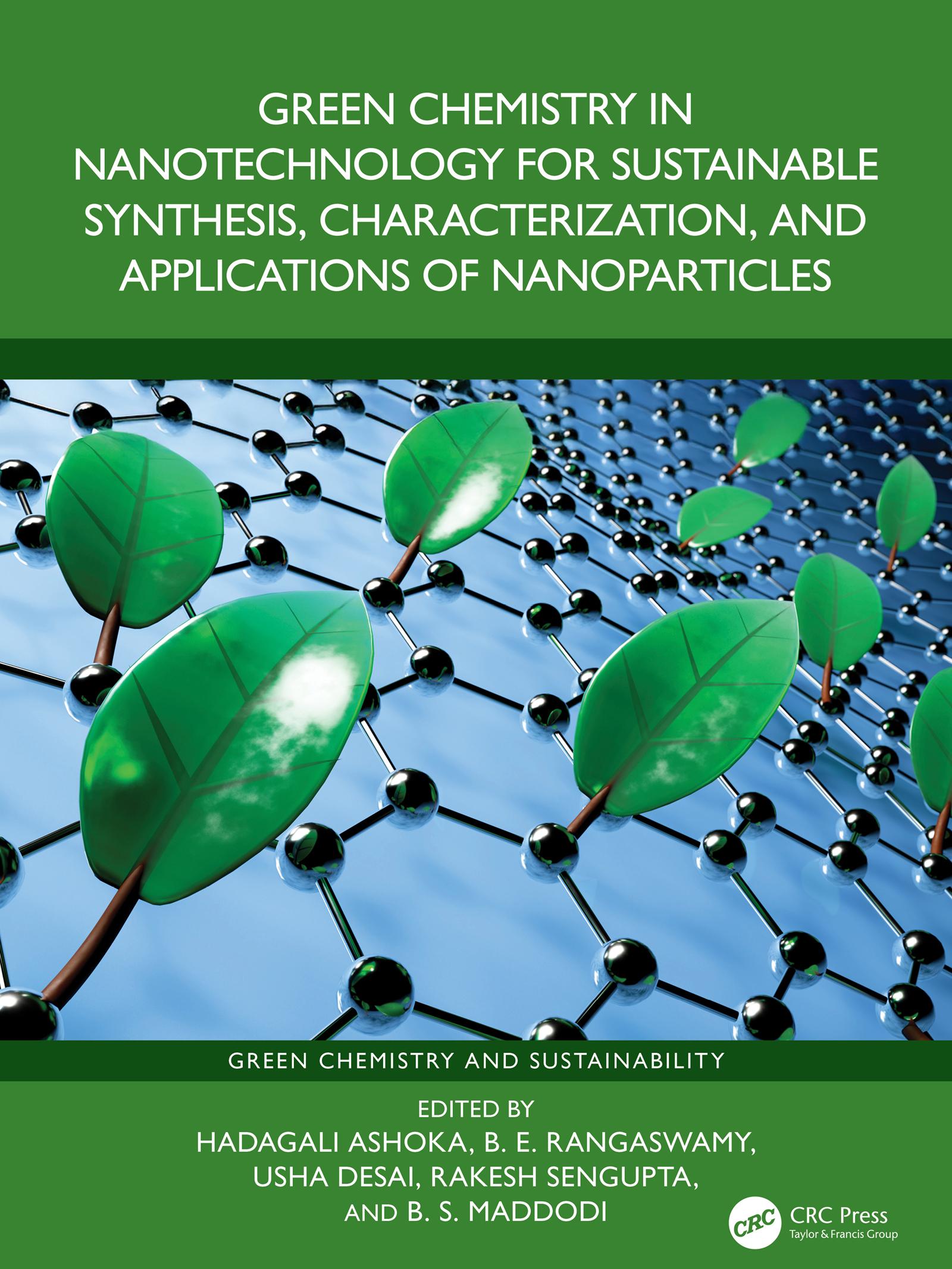
Nanotechnology has become one of the most revolutionary scientific domains of the 21st century, providing answers for healthcare, renewable energy, environmental cleanup, and industrial advancements. Nonetheless, the swift expansion of this technology necessitates a comparable dedication to environmental responsibility and safety. Green Chemistry in Nanotechnology for Sustainable Synthesis, Characterization, and Applications of Nanoparticles meets this requirement by combining green chemistry principles with cutting-edge nanoscience.
This edited collection offers an extensive summary of sustainable nanomaterial creation, starting with fundamental principles and synthesis methods based on renewable resources. It explores eco-friendly and bioinspired methods for producing gold, silver, calcium, and metal oxide nanoparticles, backed by in-depth case studies. Extensive coverage is provided on advanced characterization techniques, delivering insights into structural, morphological, and functional assessment. The book examines various applications, such as food packaging, antimicrobial surfaces, catalytic processes, energy devices, and biomedical technologies.
A specific part on nanotoxicology showcases contemporary safety evaluation techniques, including organs-on-chips and 3D cell culture systems, while conversations regarding ethics and sustainability stress responsible innovation. The combination of scientific, safety, and social factors sets this work apart in its breadth.
By connecting core concepts with real-world uses, the book acts as an essential tool for researchers, scholars, and industry experts aiming to create nanotechnology solutions that are not only efficient but also safe, sustainable, and ethically responsible. Policymakers and regulatory organizations will also appreciate it for developing frameworks that guarantee nanotechnology aids in advancing global sustainability objectives.
This book merges green chemistry with nanotechnology, enabling synthesis from sustainable pathways and characterization through advanced techniques jointly with applications and ethical considerations all under one roof. Works by world top-rated scientists propose renewable-resource-based, bioinspired, and eco-friendly routes toward synthesis of widely varying nanoparticles that make sense in real life. Case studies with applications in health care, food packaging, catalysis, and industrial plus environmental remediation work supported by the most advanced tools of nanotoxicological assessment, such as organs-on-chips and 3D cell cultures, are also presented here. Scientific novelty will be integrated with safety and sustainability so that learners can not only create new forms of nanomaterials but also “create safely.” By combining breadth, depth, and practical insight, this work stands as an indispensable guide for researchers, industry professionals, policymakers, and educators shaping the future of sustainable nanotechnology.
Betal nemt med kort, Klarna, Apple Pay eller Google Pay. Ikke tilfreds? Du har altid 14 dages fortrydelsesret. Læs mere i vores vilkår. Har du spørgsmål, så send os en mail på hello@memmo.org.
Memmo gør det nemmere at studere – uanset hvor du er i verden. Hos os samler du dine kursusbøger og smarte studieværktøjer ét sted: resuméer, quizzer, podcasts og flashcards. Og så er der Ted, din studieven, der svarer på alt, du undrer dig over. Over 50 000 studerende studerer allerede her – bygget til at hjælpe dig med at lære hurtigere og stresse mindre.