
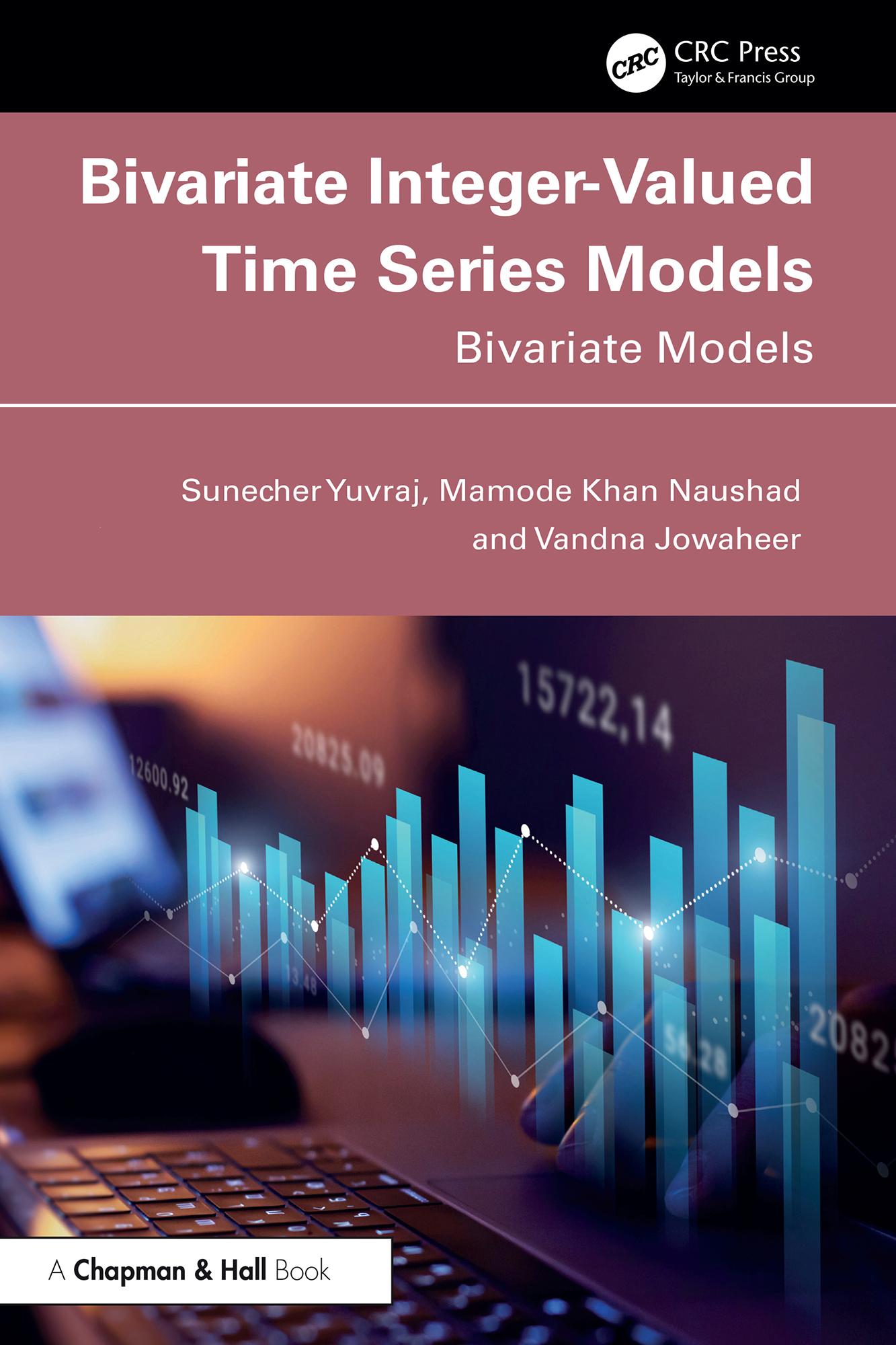
This book proposes some novel models based on the autoregressive and moving average structures under various distributional assumptions of the innovation series for analysing non-stationary bivariate time series of counts.
Time series of count responses are recorded for different correlated variables which may be marginally dispersed relative to their means, may exhibit different levels of dispersion and may be commonly influenced by one or more dynamic explanatory variables. Analysis of such type of bivariate time series data is quite challenging and the challenge mounts up further if these time series are non-stationary. This book proposes some bivariate models that allow for different levels of dispersion as well as non-stationarity. Specifically, BINAR(1) and BINMA(1) models under Poisson, NB and COM-Poisson innovations are constructed and tested. Another important contribution of this book is in developing a novel estimation procedure for estimating the parameters of the proposed BINAR(1) and BINMA(1) models. Hence, a new estimation approach based on the GQL is proposed. Monte-Carlo simulations are implemented to assess the performance of the GQL. In some simple cases of stationarity, we also compare the GQL with the other estimation techniques such as CMLE and FGLS.
This book is a useful resource for undergraduate students, postgraduate students, researchers and academics in the field of time series models.
Betal nemt med kort, Klarna, Apple Pay eller Google Pay. Ikke tilfreds? Du har altid 14 dages fortrydelsesret. Læs mere i vores vilkår. Har du spørgsmål, så send os en mail på hello@memmo.org.
Memmo gør det nemmere at studere – uanset hvor du er i verden. Hos os samler du dine kursusbøger og smarte studieværktøjer ét sted: resuméer, quizzer, podcasts og flashcards. Og så er der Ted, din studieven, der svarer på alt, du undrer dig over. Over 50 000 studerende studerer allerede her – bygget til at hjælpe dig med at lære hurtigere og stresse mindre.