
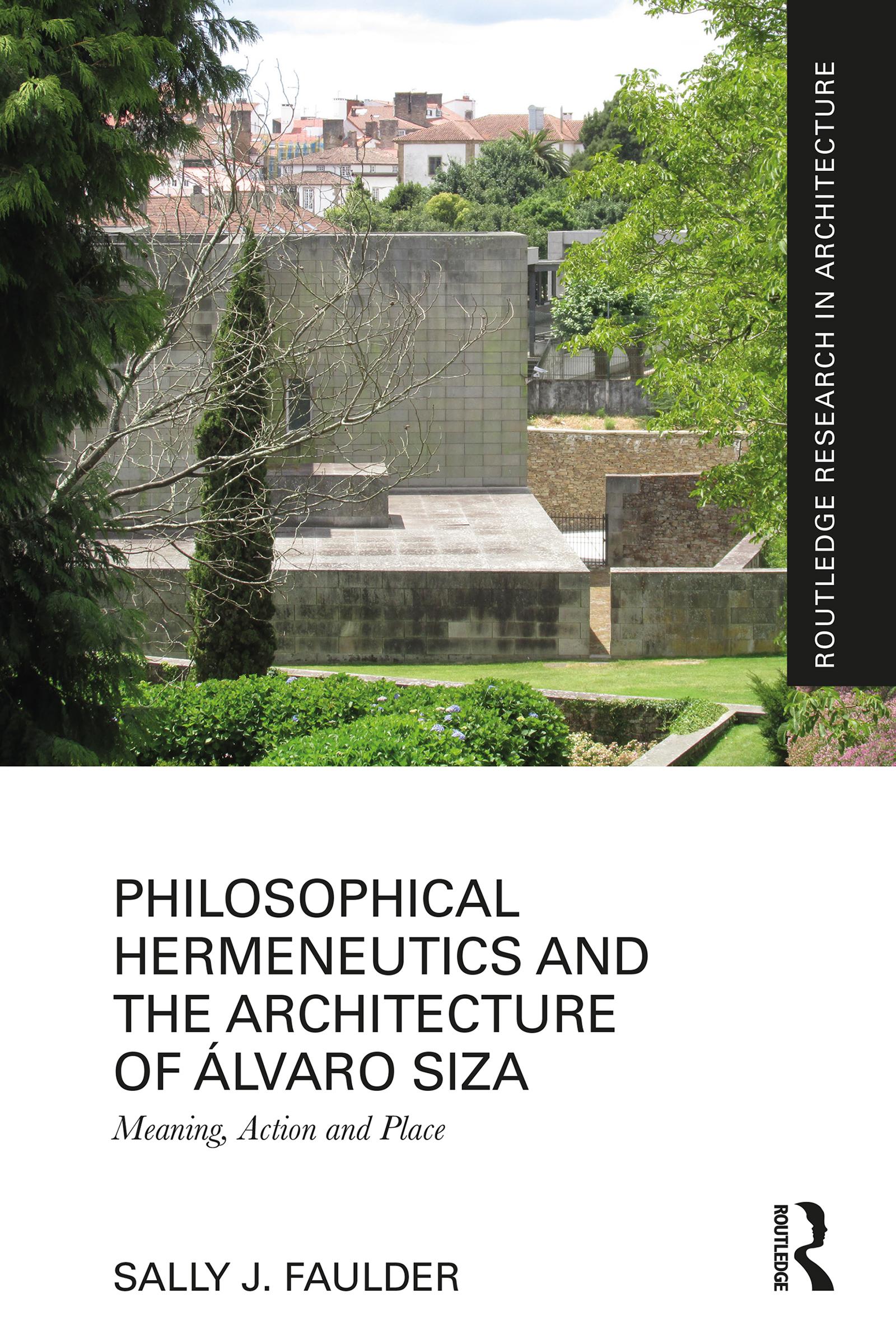
This book presents an original study of the work of Pritzker Prize-winning Portuguese architect Álvaro Siza from the perspective of architecture as an interpretation of human life. It combines philosophical hermeneutics, narrative textual description, and history and theory research to provide a rich account of Siza’s work.
The book gives a detailed analysis of three of Siza’s works from this perspective: the Tidal Pool (Piscina das Marés) in Leça da Palmeira, Portugal; the Galician Centre of Contemporary Art (Centro Galego de Arte Contemporánea) in Santiago de Compostela, Spain; and the Santa Maria Church in Marco de Canaveses, Portugal. This form of analysis provides insight into the unique temporal dimension of Siza’s work, both in the memory inscribed by the structure and in how what is inscribed is revealed by degrees to those who come into contact with it. Drawing on Hans-Georg Gadamer and Paul Ricoeur, this book defines both building and inhabiting as acts of interpretation. Through employing the technique of writing architecture as a mode of phenomenological description, the book uses one form of creative configuration – narrative – to draw out the meaning inscribed in another form of creative configuration – architecture.
The book contributes a unique perspective to scholarship on Siza and an in-depth study to the growing field of hermeneutics of architecture. It will be of interest to researchers and students of architecture and philosophy.
Betal nemt med kort, Klarna, Apple Pay eller Google Pay. Ikke tilfreds? Du har altid 14 dages fortrydelsesret. Læs mere i vores vilkår. Har du spørgsmål, så send os en mail på hello@memmo.org.
Memmo gør det nemmere at studere – uanset hvor du er i verden. Hos os samler du dine kursusbøger og smarte studieværktøjer ét sted: resuméer, quizzer, podcasts og flashcards. Og så er der Ted, din studieven, der svarer på alt, du undrer dig over. Over 50 000 studerende studerer allerede her – bygget til at hjælpe dig med at lære hurtigere og stresse mindre.