
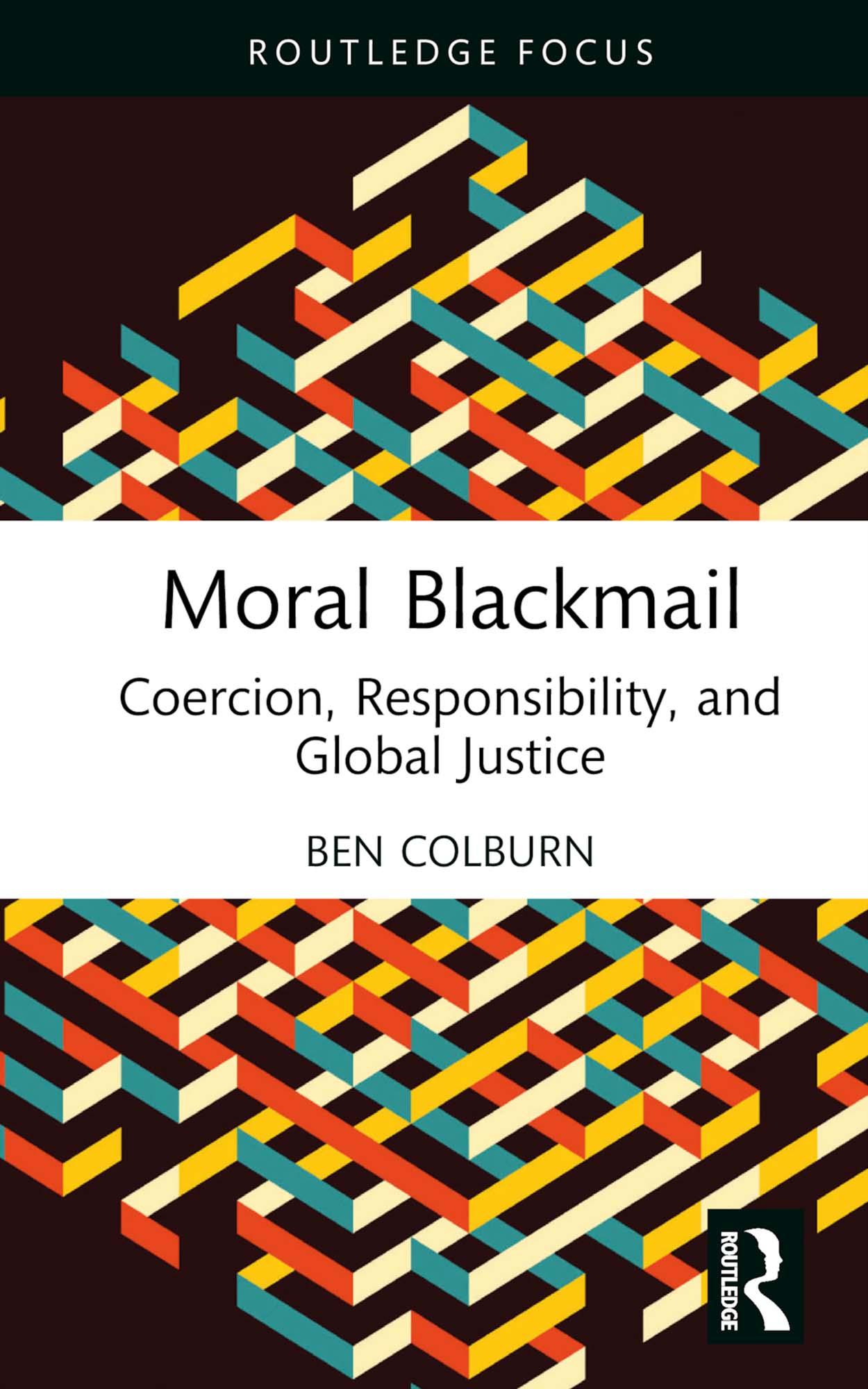
Moral Blackmail: Coercion, Responsibility, and Global Justice identifies a novel kind of forced action, yet one that is relatively neglected in ethics and moral philosophy. Moral blackmail occurs when someone is forced to do something because someone else has made all its alternatives morally unacceptable.
Ben Colburn explores moral blackmail by first examining existing theories of coercion, responsibility, and voluntary action, and defending its existence from various sceptical metaethical arguments, before arguing that moral blackmail's significance is not limited to the interpersonal: it is also endemic in the structures of distribution and decision-making at the largest scale. To show this, he considers two problems in intergenerational and international justice: the problem of ‘passing the buck’ in environmental and population policies in the former, and the problem of ‘taking up the slack’ in situations of partial compliance with the demands of the latter. Recognising these as instances of moral blackmail writ large offers novel solutions to these long-standing philosophical problems, as well as offering proof in use of the account Colburn proposes.
Moral Blackmail will be of interest to those studying and researching political philosophy, ethical theory, applied ethics, and politics.
Betal nemt med kort, Klarna, Apple Pay eller Google Pay. Ikke tilfreds? Du har altid 14 dages fortrydelsesret. Læs mere i vores vilkår. Har du spørgsmål, så send os en mail på hello@memmo.org.
Memmo gør det nemmere at studere – uanset hvor du er i verden. Hos os samler du dine kursusbøger og smarte studieværktøjer ét sted: resuméer, quizzer, podcasts og flashcards. Og så er der Ted, din studieven, der svarer på alt, du undrer dig over. Over 50 000 studerende studerer allerede her – bygget til at hjælpe dig med at lære hurtigere og stresse mindre.