
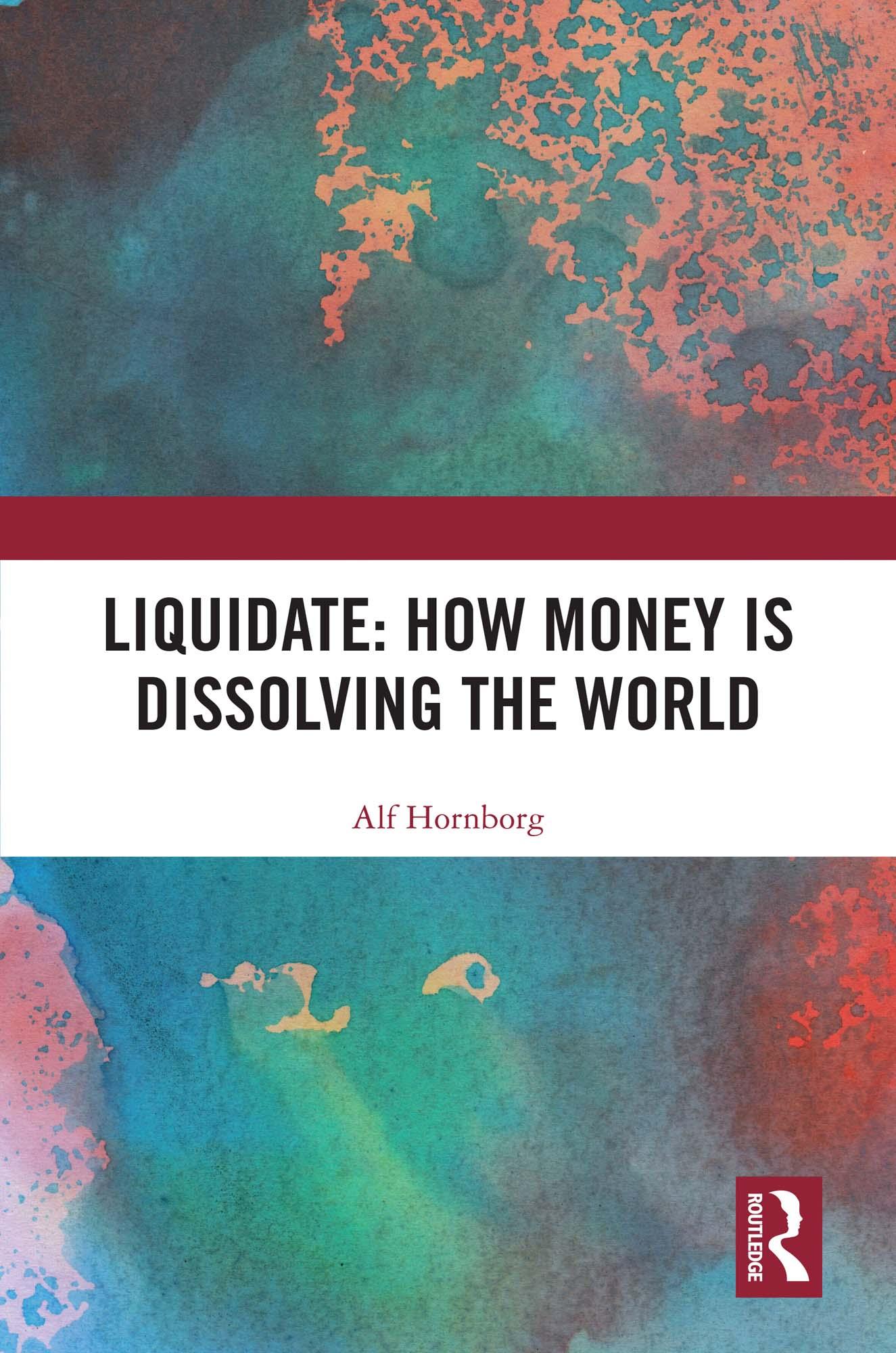
Liquidate: How Money is Dissolving the World examines the emergence of money and its social and ecological repercussions. It views money as a new phenomenon in the evolution of life that has fundamentally transformed ecosystems and human social relations.
The appearance of coined money around 600 BCE coincided with the first abstract philosophies and religions. This book shows how changes in human–environmental relations have reflected changes in social relations generated by money. The detached modern view of nature mirrors the socially detached modern individual. However, the abandonment of animism has not diminished the human propensity for fetishism – the perception of artefacts such as money tokens as indexes of what they represent. Market prices obscure the asymmetric global resource transfers that make increasingly advanced technologies possible where there is enough money. Our fetishised understandings of money and technologies cannot deal with the escalating production of entropy underlying climate change. They also drive the dramatic reduction of biological and cultural diversity under globalisation. Given these problems, many people reassess premodern and indigenous societies in search of more sustainable ideas on how to organise exchange.
Liquidate: How Money is Dissolving the World will be of interest to scholars working in anthropology, sociology, economics, history, semiotics, comparative religions, and indigenous studies.
Betal nemt med kort, Klarna, Apple Pay eller Google Pay. Ikke tilfreds? Du har altid 14 dages fortrydelsesret. Læs mere i vores vilkår. Har du spørgsmål, så send os en mail på hello@memmo.org.
Memmo gør det nemmere at studere – uanset hvor du er i verden. Hos os samler du dine kursusbøger og smarte studieværktøjer ét sted: resuméer, quizzer, podcasts og flashcards. Og så er der Ted, din studieven, der svarer på alt, du undrer dig over. Over 50 000 studerende studerer allerede her – bygget til at hjælpe dig med at lære hurtigere og stresse mindre.