
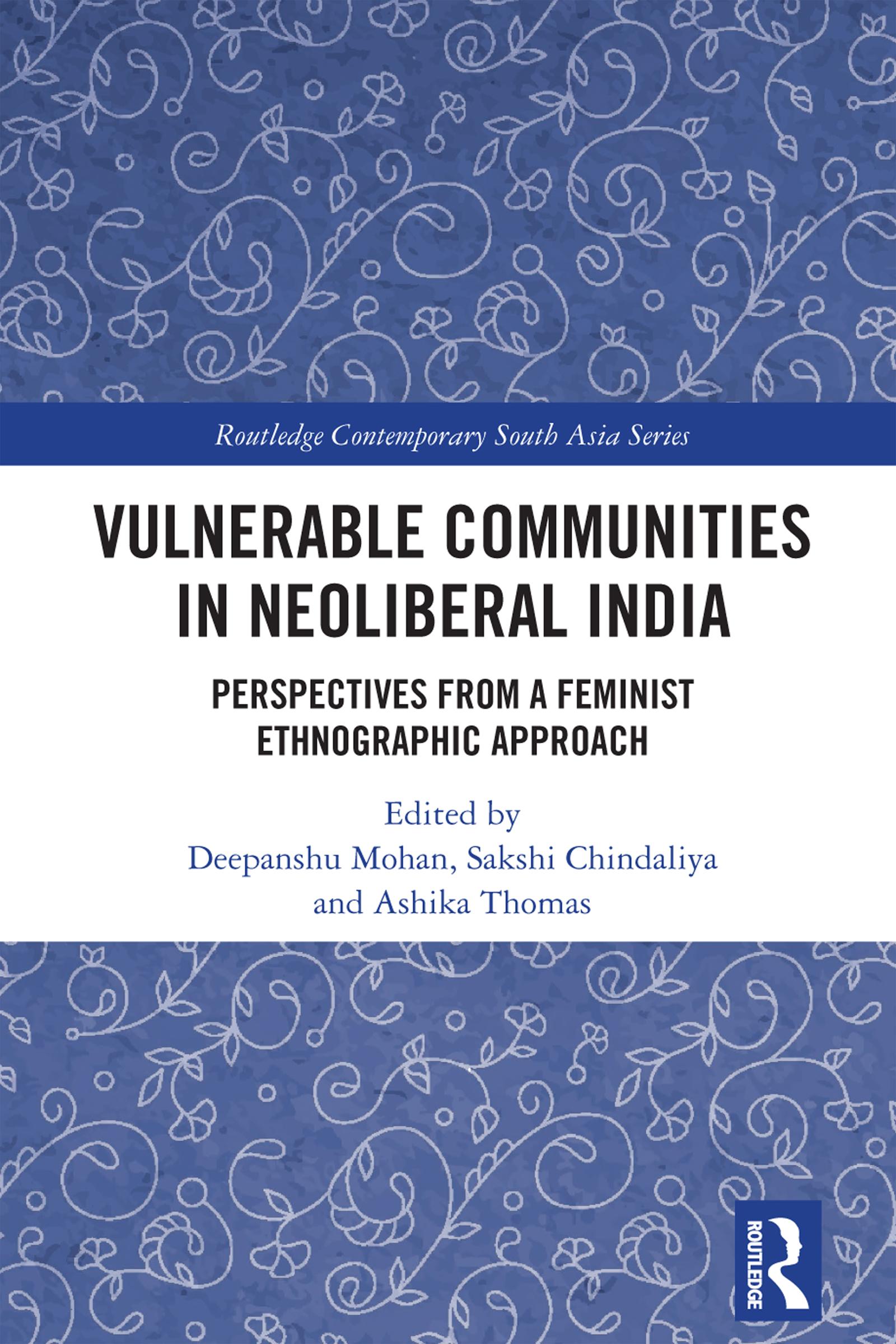
Mohan, Chindaliya, and Thomas offer an ethnographic critique of modern, neoliberal India from the perspective of studying the daily lives-livelihoods of marginalised, unsecured, informal vulnerable communities residing in the urban, peri-urban spaces across the nation.
With case studies ranging from groups of pastoralists, fisher-folk, and handicraft workers of Kashmir to the weavers of Kutch, and the factory workers and artisans of the Delhi capital, this edited volume of feminist ethnographies cover previously undocumented geographical and socio-cultural contexts of vulnerable groups, put together by the Centre for New Economics Studies, O.P. Jindal Global University. The diverse range of ethnographic case studies further explore the invisibilisation of the growing informal sector in India’s labor market, studied through the applied concepts of Gayatri Spivak’s othering, Doreen Massey’s power geometries and Pierre Bourdieu’s (fractured) habitus. In addition to providing visual narratives of daily lifestyle, livelihoods of identified communities, our ethnographic analysis is rooted in discussing feminist paradigms from each study’s respondents.
A useful read for scholars and policymakers interested in understanding intersectional applications of development studies in context of the unsecured workforce in India, with application across disciplines of social-economic anthropology of South Asia, using the methodological lens of experimental ethnography.
Betal nemt med kort, Klarna, Apple Pay eller Google Pay. Ikke tilfreds? Du har altid 14 dages fortrydelsesret. Læs mere i vores vilkår. Har du spørgsmål, så send os en mail på hello@memmo.org.
Memmo gør det nemmere at studere – uanset hvor du er i verden. Hos os samler du dine kursusbøger og smarte studieværktøjer ét sted: resuméer, quizzer, podcasts og flashcards. Og så er der Ted, din studieven, der svarer på alt, du undrer dig over. Over 50 000 studerende studerer allerede her – bygget til at hjælpe dig med at lære hurtigere og stresse mindre.