
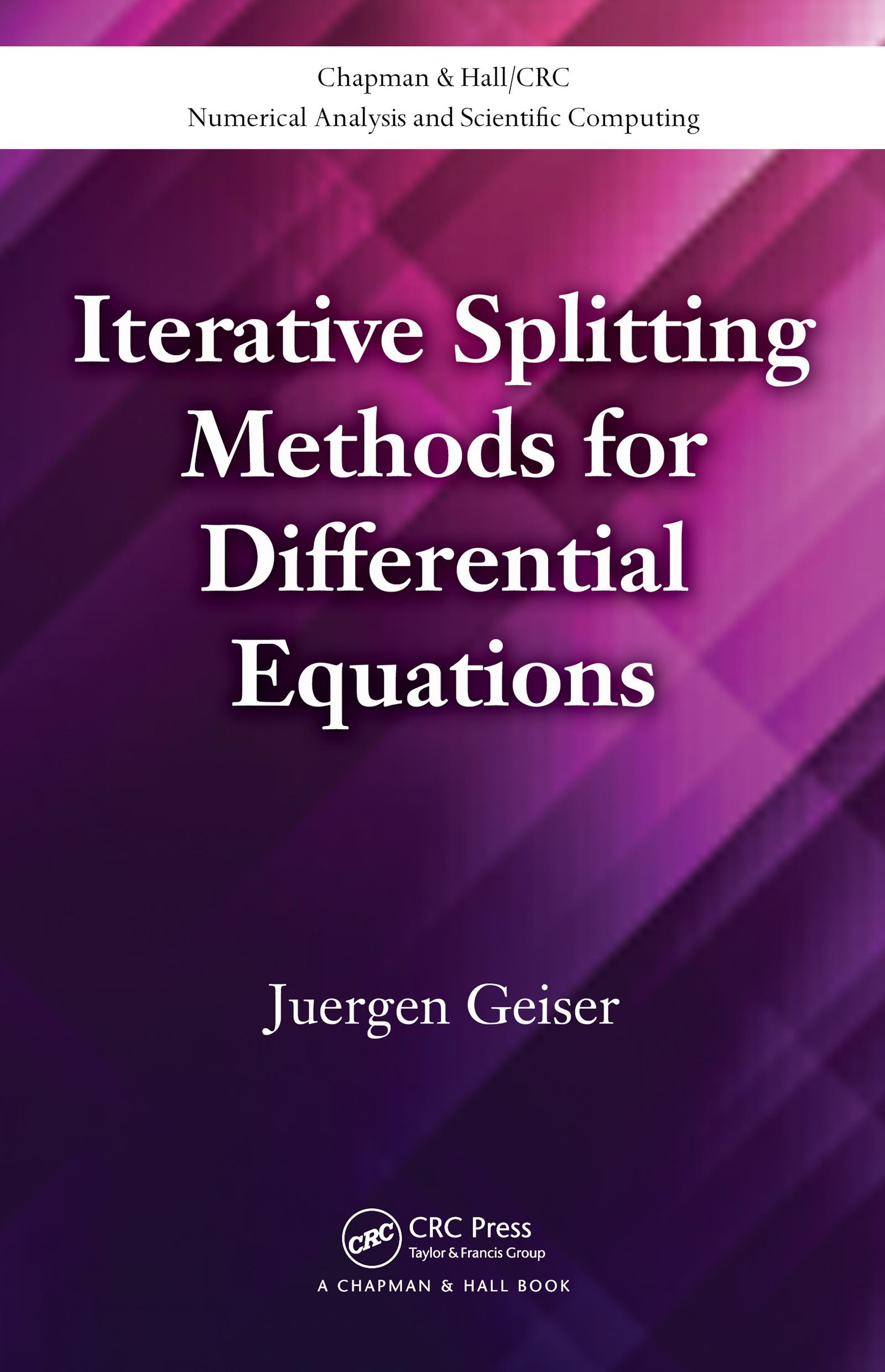
Iterative Splitting Methods for Differential Equations explains how to solve evolution equations via novel iterative-based splitting methods that efficiently use computational and memory resources. It focuses on systems of parabolic and hyperbolic equations, including convection-diffusion-reaction equations, heat equations, and wave equations.
In the theoretical part of the book, the author discusses the main theorems and results of the stability and consistency analysis for ordinary differential equations. He then presents extensions of the iterative splitting methods to partial differential equations and spatial- and time-dependent differential equations.
The practical part of the text applies the methods to benchmark and real-life problems, such as waste disposal, elastics wave propagation, and complex flow phenomena. The book also examines the benefits of equation decomposition. It concludes with a discussion on several useful software packages, including r3t and FIDOS.
Covering a wide range of theoretical and practical issues in multiphysics and multiscale problems, this book explores the benefits of using iterative splitting schemes to solve physical problems. It illustrates how iterative operator splitting methods are excellent decomposition methods for obtaining higher-order accuracy.
Betal nemt med kort, Klarna, Apple Pay eller Google Pay. Ikke tilfreds? Du har altid 14 dages fortrydelsesret. Læs mere i vores vilkår. Har du spørgsmål, så send os en mail på hello@memmo.org.
Memmo gør det nemmere at studere – uanset hvor du er i verden. Hos os samler du dine kursusbøger og smarte studieværktøjer ét sted: resuméer, quizzer, podcasts og flashcards. Og så er der Ted, din studieven, der svarer på alt, du undrer dig over. Over 50 000 studerende studerer allerede her – bygget til at hjælpe dig med at lære hurtigere og stresse mindre.