
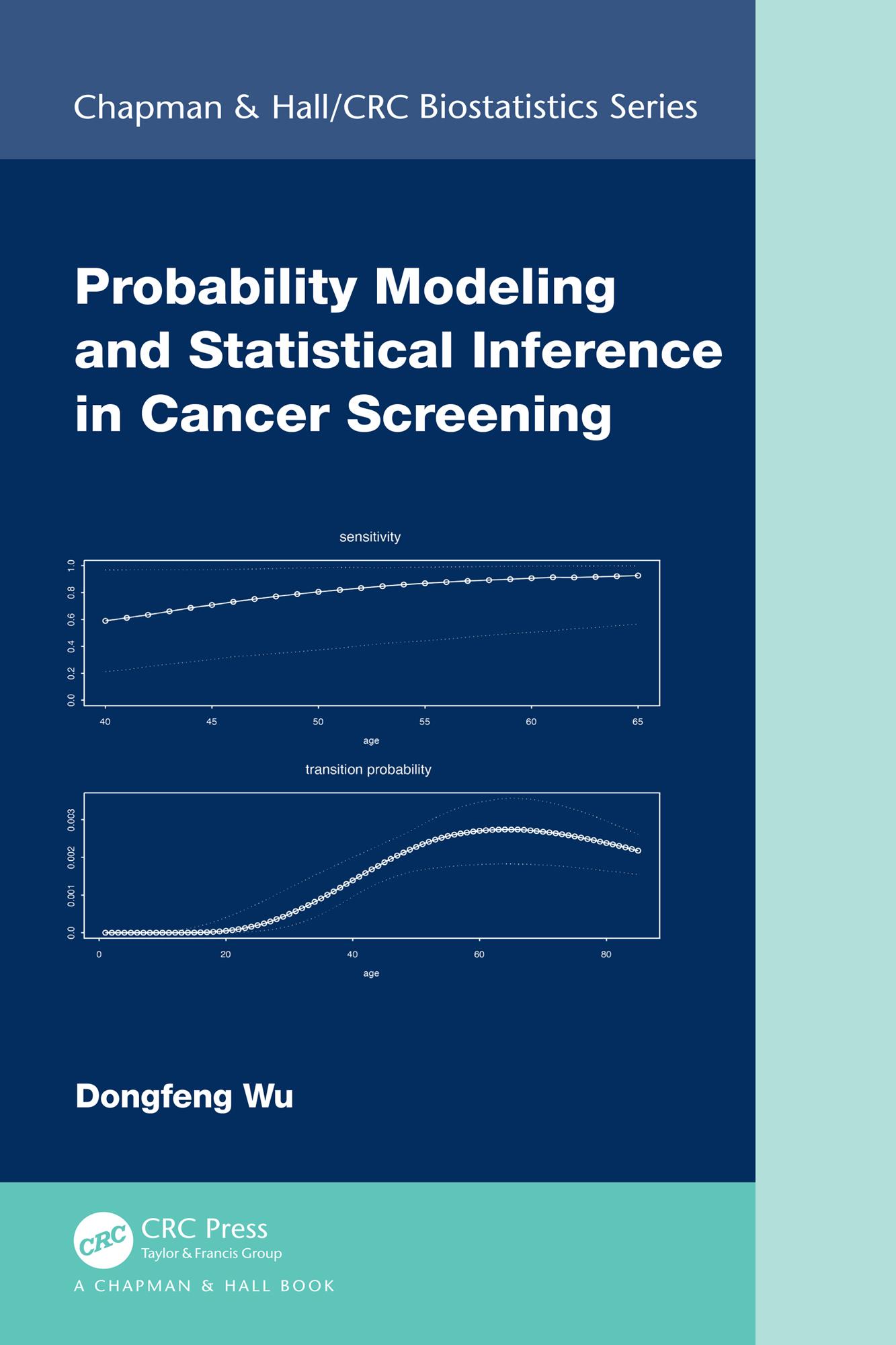
Cancer screening has been carried out for six decades – however, there are many unsolved problems: how to estimate key parameters involved in screenings, such as sensitivity, the time duration in the preclinical state (i.e., sojourn time), and time duration in the disease-free state; how to estimate the distribution of lead time, the diagnosis time advanced by screening; how to evaluate the long-term outcomes of screening, including the probability of overdiagnosis among the screen-detected; when to schedule the first exam based on one’s current age and risk tolerance; and when to schedule the upcoming exam based on one’s screening history, age, and risk tolerance. These problems need proper probability models and statistical methods in order to be dealt with.
Features:
- This book gives a concise account of the analysis of cancer screening data, using probability models and statistical methods.
- Real data sets are provided so that cancer researchers and statisticians can apply the methods in the learning process.
- It develops statistical methods in the commonly used disease progressive model.
- It provides solutions to practical problems and introduces open problems.
- It provides a framework for the most recent developments based on the author’s research.
The book is primarily aimed at researchers and practitioners from biostatistics and cancer research. Readers should have the prerequisite knowledge of calculus, probability, and statistical inference. The book could be used as a one-semester textbook on the topic of cancer screening methodology for a graduate-level course.
Betal nemt med kort, Klarna, Apple Pay eller Google Pay. Ikke tilfreds? Du har altid 14 dages fortrydelsesret. Læs mere i vores vilkår. Har du spørgsmål, så send os en mail på hello@memmo.org.
Memmo gør det nemmere at studere – uanset hvor du er i verden. Hos os samler du dine kursusbøger og smarte studieværktøjer ét sted: resuméer, quizzer, podcasts og flashcards. Og så er der Ted, din studieven, der svarer på alt, du undrer dig over. Over 50 000 studerende studerer allerede her – bygget til at hjælpe dig med at lære hurtigere og stresse mindre.