
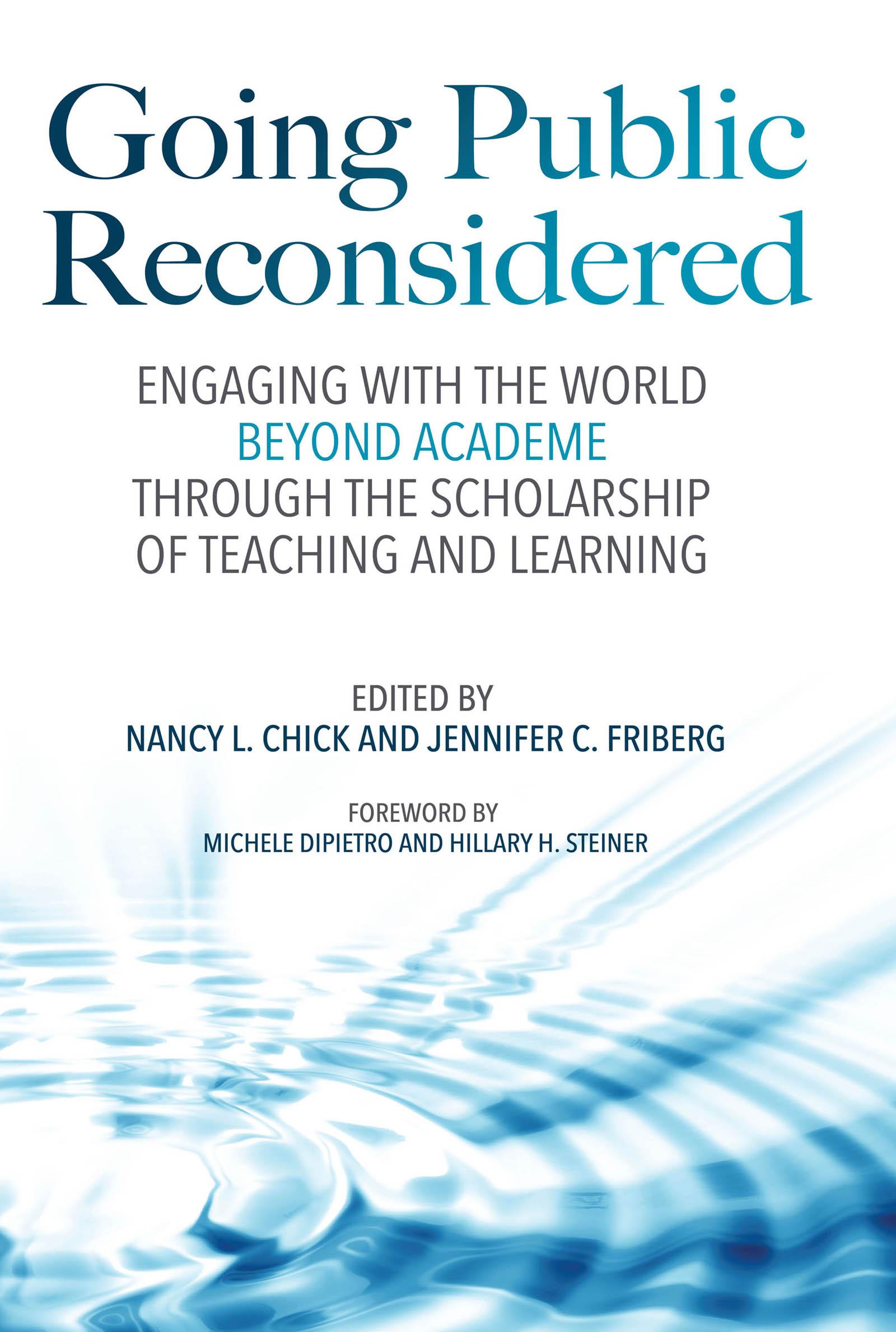
Through its impact on students in their lives in and beyond college, and recognizing the porous boundary between the classroom and the “real world,” SoTL can offer insights into broader societal issues, offer evidence of activities that facilitate everyday learning, promote intrinsic motivation, better support people from underrepresented communities, or uncover the ripple effects of changing educational environments. It has the potential to deliver messages of broad public interest. This book extends the field-building work of Boyer’s Scholarship Reconsidered and Hutchings, Huber, and Ciccone’s The Scholarship of Teaching and Learning Reconsidered by taking a new look at SoTL’s ubiquitous call to “go public.” Going Public Reconsidered explores the potential impacts of knowledge generated by SoTL, considers its varied public audiences, and offers guidance for the appropriate media and modes of communication to reach them, including the use of social media. It urges the SoTL community to step up and contribute its expertise to conversations about the crises that face our communities, nations, and the world, and disseminate the relevance of its research for the world outside of the classroom.Recognizing that many practitioners find it difficult to conceptualize the public in public SoTL beyond the higher education audiences they routinely address, this book focusses on conceptualizing, planning, and shaping the message, and clarifying appropriate audiences. It offers guidance on the “who” and the “how” of public SoTL. Going Public Reconsidered addresses such questions as: ● What is happening in the world that would benefit from a SoTL-informed perspective?● What information, insight, or knowledge does SoTL generate?● Who beyond higher education might care about this information, insight, or knowledge, and why?● How can we adapt to the venues and platforms where they currently get their information and knowledge?The fifteen editors and contributors explore the potential and the implications of extending SoTL beyond its current horizons by reflecting on the ultimate responsibility of those who profess SoTL; examining SoTL’s audiences and the notion of “the public”; considering what topics and Grand Challenges public SoTL might address; offering case studies of outreach in the US and abroad; and providing guidance on the use of social media for public SoTL – from Twitter, Facebook, LinkedIn, and YouTube to blogs – as well as on developing relationships with mainstream media. The book’s message is that public SoTL isn’t a radical departure from SoTL-as-we-know-it, but a natural expansion of its methods and goals, offering the potential of broadening its impact domestically and internationally. It offers inspiration and challenges to practitioners across the globe.
Betal nemt med kort, Klarna, Apple Pay eller Google Pay. Ikke tilfreds? Du har altid 14 dages fortrydelsesret. Læs mere i vores vilkår. Har du spørgsmål, så send os en mail på hello@memmo.org.
Memmo gør det nemmere at studere – uanset hvor du er i verden. Hos os samler du dine kursusbøger og smarte studieværktøjer ét sted: resuméer, quizzer, podcasts og flashcards. Og så er der Ted, din studieven, der svarer på alt, du undrer dig over. Over 50 000 studerende studerer allerede her – bygget til at hjælpe dig med at lære hurtigere og stresse mindre.