
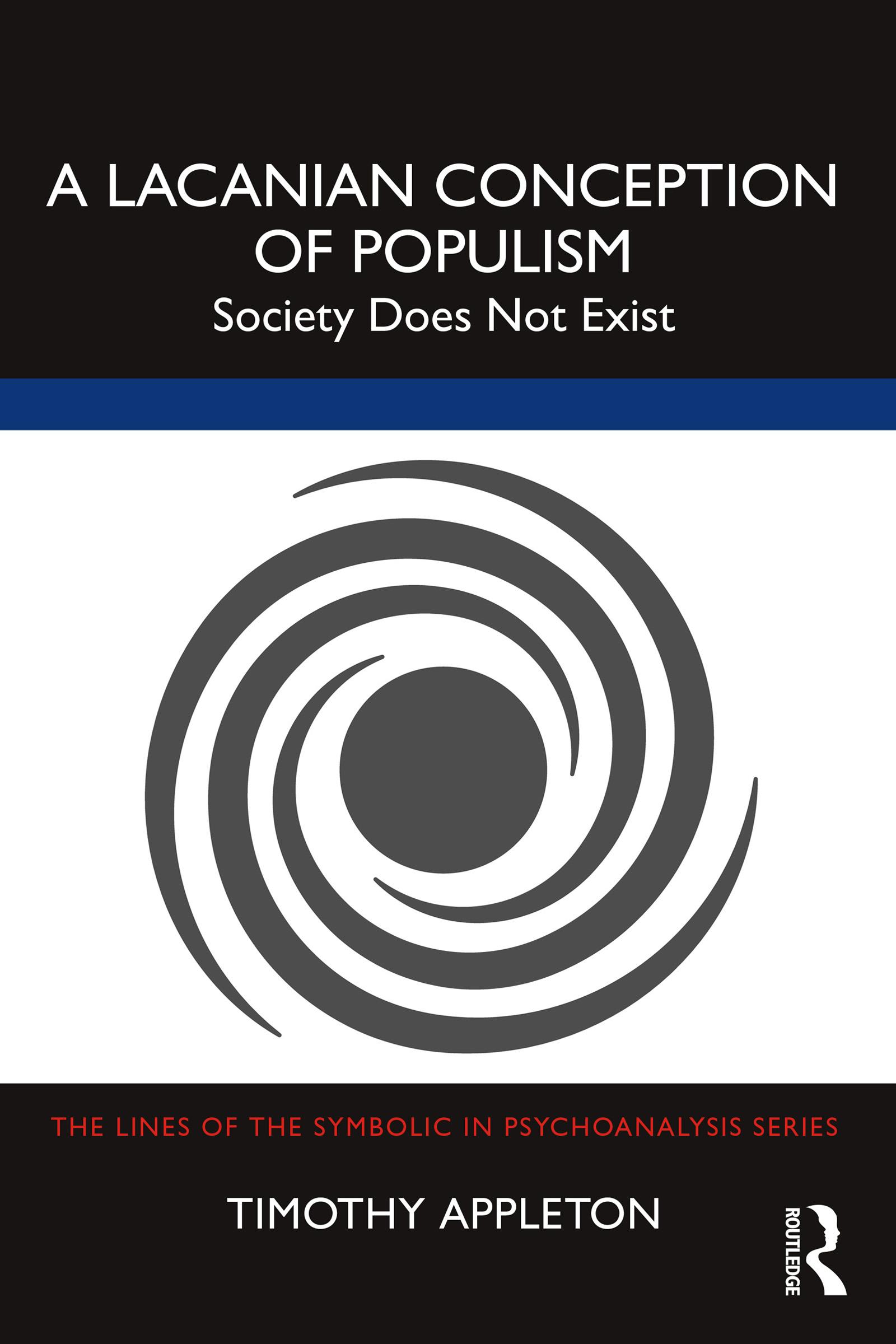
A Lacanian Conception of Populism takes issue with traditional theories of populism, which seek to equate populism with hegemony, arguing that these are not only different but even incompatible logics.
Timothy Appleton contends that one of the main differences between populism and hegemony has to do with the social totality: while hegemony absolutises it, populism eviscerates it, setting in its place an (apparently paradoxical) dispersion of singular instances of ‘the people’. The book considers the work of Laclau, Badiou, Žižek and Rancière, before arriving at a novel conceptualisation that Appleton dubs ‘the populism of singularities’. In the second half of the book, the author draws out the consequences of this concept for contemporary political theory: the question of how to define ‘left’ and ‘right’; the question of popular enthusiasm and affect; ‘truth’ versus ‘post-truth’; the question of leadership; populism and nationalism; and the relation between populism and political parties.
A Lacanian Conception of Populism will be key reading for academics and scholars of political theory, political philosophy, post-Marxist thought, discourse theory and psychoanalysis. It will also be of interest to those working in the areas of populism studies, cultural studies, gender studies and queer theory.
Betal nemt med kort, Klarna, Apple Pay eller Google Pay. Ikke tilfreds? Du har altid 14 dages fortrydelsesret. Læs mere i vores vilkår. Har du spørgsmål, så send os en mail på hello@memmo.org.
Memmo gør det nemmere at studere – uanset hvor du er i verden. Hos os samler du dine kursusbøger og smarte studieværktøjer ét sted: resuméer, quizzer, podcasts og flashcards. Og så er der Ted, din studieven, der svarer på alt, du undrer dig over. Over 50 000 studerende studerer allerede her – bygget til at hjælpe dig med at lære hurtigere og stresse mindre.