
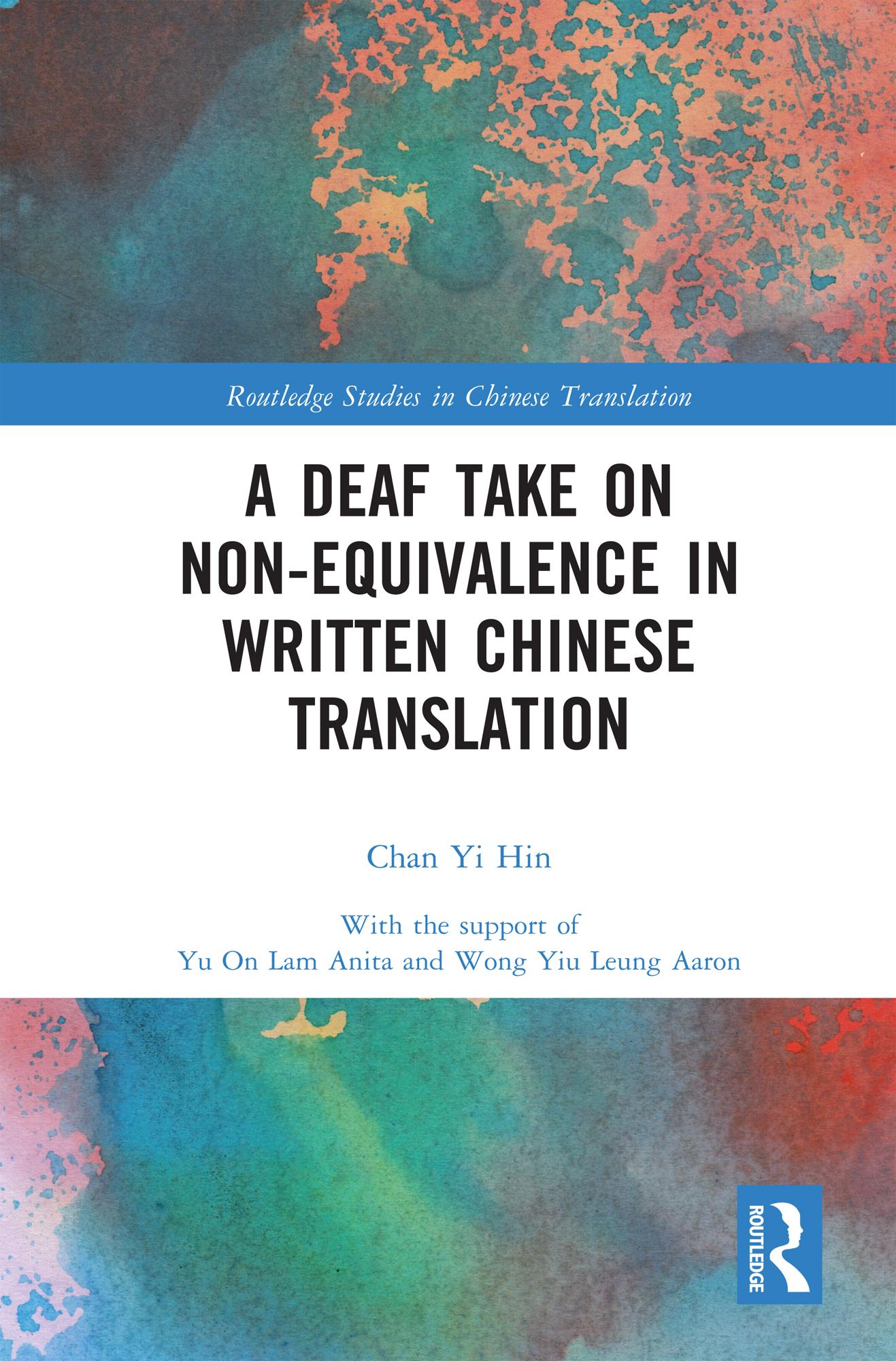
A Deaf Take on Non-Equivalence in Written Chinese Translation examines the issue of lexical non-equivalence between written Chinese and Hong Kong Sign Language (HKSL) translation, describing its theoretical and practical implications.
This research foregrounds the semiotic resources in the Deaf community of Hong Kong by analyzing translation strategies exhibited by Deaf Hongkongers when they were invited to translate written Chinese passages with specialized and culturally specific concepts in a monologic setting. With discourse analysis as a framework, the major findings of this research were that: (1) a taxonomy of strategies featured depiction, manual representations of Chinese characters and visual metonymy, writing and mouthing; (2) employment of multisemiotic and multimodal resources gave intended viewers access to different facets of meaning; and (3) repeated renditions of the same concepts gave rise to condensed, abbreviated occasionalisms.
Observations from this research serve as a point of reference for interpreting scholars, practitioners and students as well as policymakers who formulate interpretation service provision and assessment.
Betal nemt med kort, Klarna, Apple Pay eller Google Pay. Ikke tilfreds? Du har altid 14 dages fortrydelsesret. Læs mere i vores vilkår. Har du spørgsmål, så send os en mail på hello@memmo.org.
Memmo gør det nemmere at studere – uanset hvor du er i verden. Hos os samler du dine kursusbøger og smarte studieværktøjer ét sted: resuméer, quizzer, podcasts og flashcards. Og så er der Ted, din studieven, der svarer på alt, du undrer dig over. Over 50 000 studerende studerer allerede her – bygget til at hjælpe dig med at lære hurtigere og stresse mindre.