
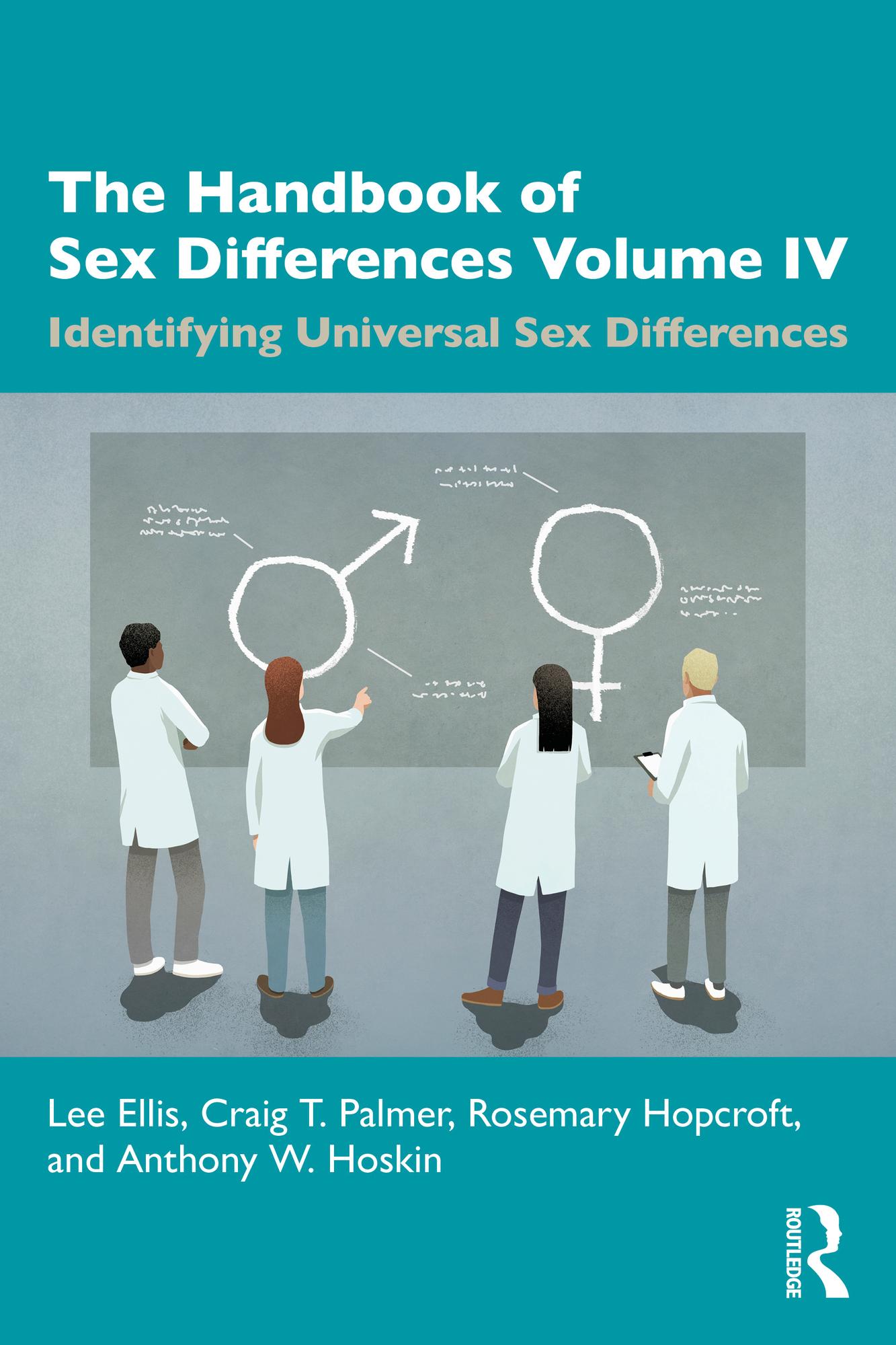
The Handbook of Sex Differences is a four-volume reference work written to assess sex differences, with a primary focus on the human species. Based on the authors’ highly influential 2008 book Sex Differences, these volumes highlight important new research findings from the last decade and a half alongside earlier findings.
In this, the work’s fourth and last volume, two related questions are addressed: Are there universal sex differences (i.e., sex differences found in all societies)? And if the answer is yes, what are they and how can each one be theoretically explained? To answer the first of these two questions, this volume condenses much of the research findings amassed in the book’s first three volumes into summary tables. Then, to help identify likely universal sex differences, three versions of social role theory and two versions of evolutionary theory are examined relative to each possible universal sex difference. Consideration is even given to religious scriptures as a sixth type of explanation. In the concluding analyses, 308 likely universal sex differences are identified. No single theory was able to explain all these differences. Nevertheless, the two evolutionary theories were better in this regard than any of the three social role theories, including the recently proposed biosocial version of social role theory.
The Handbook of Sex Differences is of importance for any researcher, student, or professional who requires a comprehensive resource on sex differences.
Betal nemt med kort, Klarna, Apple Pay eller Google Pay. Ikke tilfreds? Du har altid 14 dages fortrydelsesret. Læs mere i vores vilkår. Har du spørgsmål, så send os en mail på hello@memmo.org.
Memmo gør det nemmere at studere – uanset hvor du er i verden. Hos os samler du dine kursusbøger og smarte studieværktøjer ét sted: resuméer, quizzer, podcasts og flashcards. Og så er der Ted, din studieven, der svarer på alt, du undrer dig over. Over 50 000 studerende studerer allerede her – bygget til at hjælpe dig med at lære hurtigere og stresse mindre.