
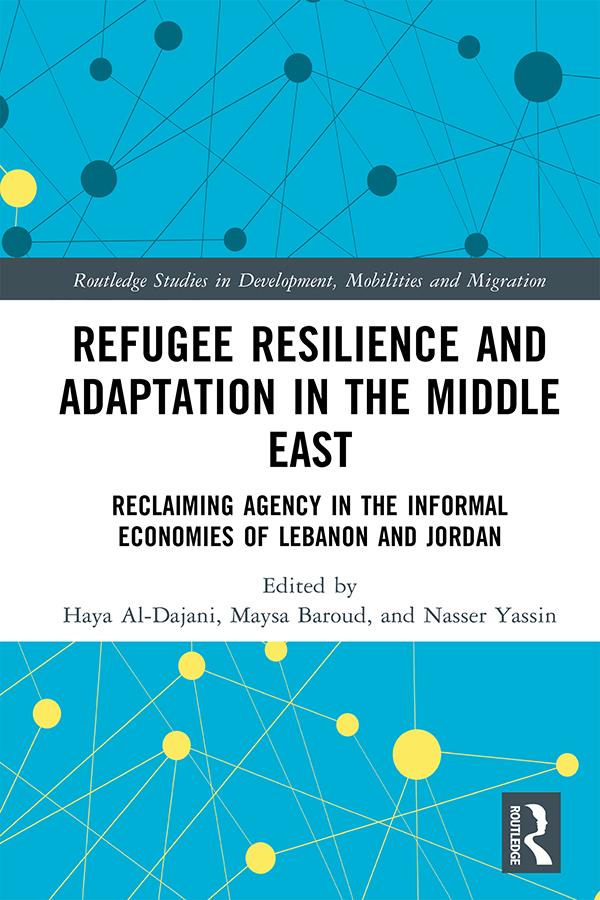
This edited volume investigates how refugee communities in the Middle East have adapted to secure their livelihoods within the informal economy.
Focusing on Lebanon and Jordan, which between 2011 and 2020 received more refugees as a proportion of their population than any other countries in the world, this edited volume investigates the informal mechanisms that Syrian refugees have adopted to fit into the informal economies of Lebanon and Jordan in the face of significant challenges and barriers. The volume investigates how legality, temporality, connectedness, gender, and geography, among other factors, have influenced the emergence of refugee communities’ informal adaptive mechanisms. Drawing on in-depth, original research among Syrian refugee tribal communities, agricultural workers, female-headed households, and micro-entrepreneurs, the volume provides tangible policy and practice recommendations to help to improve the situation of refugees and vulnerable populations that are employed in the informal economy.
Highlighting the resilience and agency demonstrated by refugees, this edited volume’s original community-based analysis will be of interest to students, researchers, and professionals from across Middle East studies, refugee studies, informal labor economics, and development studies.
Betal nemt med kort, Klarna, Apple Pay eller Google Pay. Ikke tilfreds? Du har altid 14 dages fortrydelsesret. Læs mere i vores vilkår. Har du spørgsmål, så send os en mail på hello@memmo.org.
Memmo gør det nemmere at studere – uanset hvor du er i verden. Hos os samler du dine kursusbøger og smarte studieværktøjer ét sted: resuméer, quizzer, podcasts og flashcards. Og så er der Ted, din studieven, der svarer på alt, du undrer dig over. Over 50 000 studerende studerer allerede her – bygget til at hjælpe dig med at lære hurtigere og stresse mindre.