
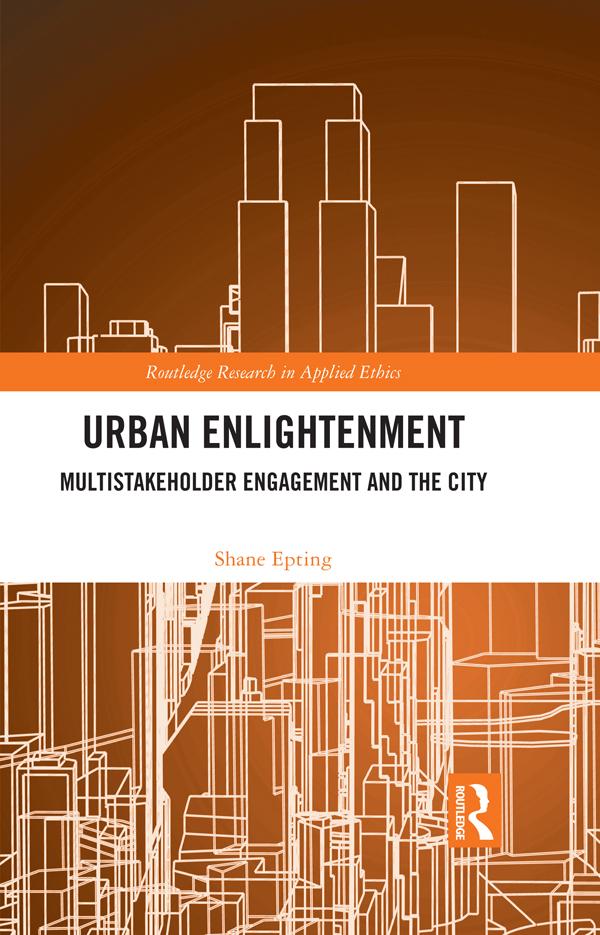
This book applies the concept of moral ordering to urban affairs. It demonstrates how multi-stakeholder engagement can enhance the quality of city life while supporting ambitions such as ethical urban sustainability and human flourishing.
While there is a history of philosophers viewing cities as technologies, cities’ encompassing nature inherently limits them. Urban sustainability matters often affect marginalized and vulnerable people, the public, nonhuman species, future generations, and urban artifacts. Problems can arise when stakeholders’ interests and needs appear at odds. The author argues in favor of the concept of moral ordering, a process designed to address issues involving different stakeholder groups such as municipal officials and residents. By employing moral ordering, a view comes into focus, revealing that the attention that each group receives reflects their place in the process, providing the necessary degree of moral respect. Finally, the author shows how moral ordering can lead to urban enlightenment. He examines real-world applications of moral ordering, such as New York City’s Participatory Budgeting Project, to make the case that municipalities can begin to bolster municipal-community relations in ways that promote urban enlightenment.
Urban Enlightenment will appeal to researchers and advanced students working in philosophy of the city, applied ethics, philosophy of technology, urban planning, environmental studies, and political science.
Betal nemt med kort, Klarna, Apple Pay eller Google Pay. Ikke tilfreds? Du har altid 14 dages fortrydelsesret. Læs mere i vores vilkår. Har du spørgsmål, så send os en mail på hello@memmo.org.
Memmo gør det nemmere at studere – uanset hvor du er i verden. Hos os samler du dine kursusbøger og smarte studieværktøjer ét sted: resuméer, quizzer, podcasts og flashcards. Og så er der Ted, din studieven, der svarer på alt, du undrer dig over. Over 50 000 studerende studerer allerede her – bygget til at hjælpe dig med at lære hurtigere og stresse mindre.