
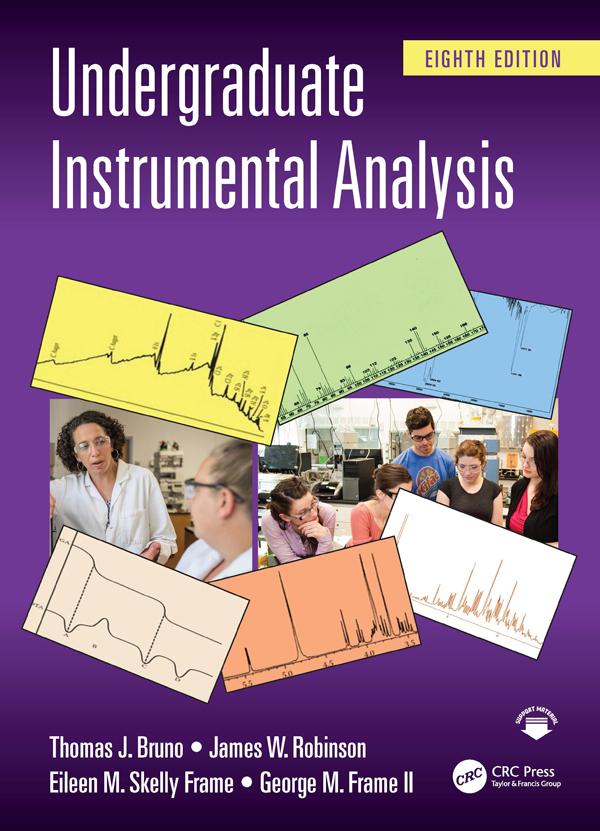
Analytical instrumentation is crucial to research in molecular biology, medicine, geology, food science, materials science, forensics, and many other fields. Undergraduate Instrumental Analysis, 8th Edition, provides the reader with an understanding of all major instrumental analyses, and is unique in that it starts with the fundamental principles, and then develops the level of sophistication that is needed to make each method a workable tool for the student. Each chapter includes a discussion of the fundamental principles underlying each technique, detailed descriptions of the instrumentation, and a large number of applications. Each chapter includes an updated bibliography and problems, and most chapters have suggested experiments appropriate to the technique.
This edition has been completely updated, revised, and expanded. The order of presentation has been changed from the 7th edition in that after the introduction to spectroscopy, UV-Vis is discussed. This order is more in keeping with the preference of most instructors. Naturally, once the fundamentals are introduced, instructors are free to change the order of presentation. Mathematics beyond algebra is kept to a minimum, but for the interested student, in this edition we provide an expanded discussion of measurement uncertainty that uses elementary calculus (although a formula approach can be used with no loss of context). Unique among all instrumental analysis texts we explicitly discuss safety, up front in Chapter 2. The presentation intentionally avoids a finger-wagging, thou-shalt-not approach in favor of a how-to discussion of good laboratory and industrial practice. It is focused on hazards (and remedies) that might be encountered in the use of instrumentation. Among the new topics introduced in this edition are:
• Photoacoustic spectroscopy.
• Cryogenic NMR probes and actively shielded magnets.
• The nature of mixtures (in the context of separations).
• Troubleshooting and leaks in high vacuum systems such as mass spectrometers.
• Instrumentation laboratory safety.
• Standard reference materials and standard reference data.
In addition, the authors have included many instrument manufacturer’s websites, which contain extensive resources. We have also included many government websites and a discussion of resources available from National Measurement Laboratories in all industrialized countries. Students are introduced to standard methods and protocols developed by regulatory agencies and consensus standards organizations in this context as well.
Betal nemt med kort, Klarna, Apple Pay eller Google Pay. Ikke tilfreds? Du har altid 14 dages fortrydelsesret. Læs mere i vores vilkår. Har du spørgsmål, så send os en mail på hello@memmo.org.
Memmo gør det nemmere at studere – uanset hvor du er i verden. Hos os samler du dine kursusbøger og smarte studieværktøjer ét sted: resuméer, quizzer, podcasts og flashcards. Og så er der Ted, din studieven, der svarer på alt, du undrer dig over. Over 50 000 studerende studerer allerede her – bygget til at hjælpe dig med at lære hurtigere og stresse mindre.