
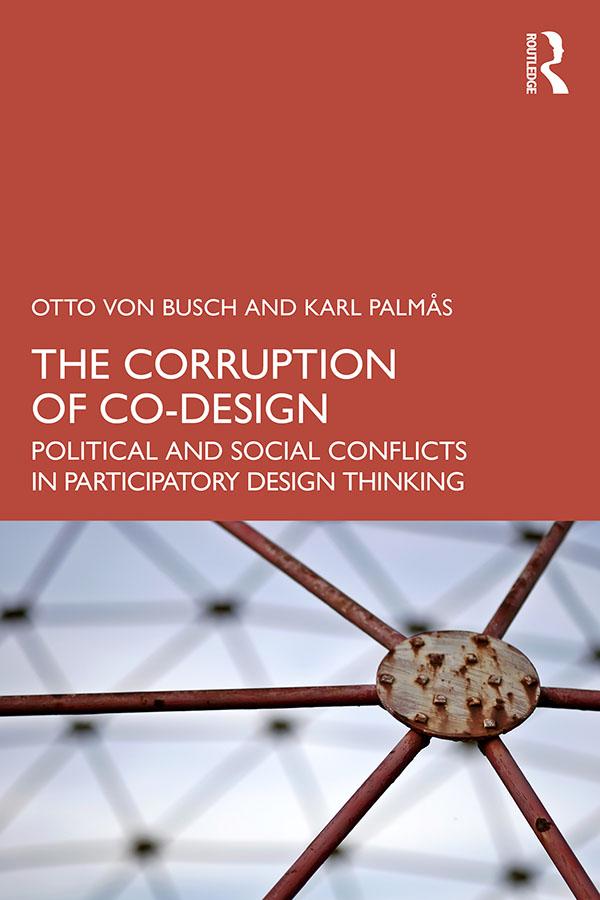
Designers are often depicted as social change agents that serve the good in the world. Similarly, co-design tends to be described as a democratic mode of creativity that is somehow beyond reproach. But is change a virtue in itself, and do participatory practices always produce socially beneficial outcomes?
Such questions are becoming more pressing as co-design has emerged as a dominant practice in planning and urban design, while also informing corporate management and public administration. In this book, Otto von Busch and Karl Palmås suggest that designers tend to overemphasize the place of ideals in design, leaving them ill-equipped to deal with a social world of power-wielding and zero-sum games. Seeking to reorient the concerns of the Scandinavian tradition of participatory design, they suggest that co-design processes are rife with betrayals, decay, and corruption, and that designerly empathy has morphed into a new form of cunning statecraft.
In putting forward Realdesign as an alternative conception of design practice, von Busch and Palmås ask: What hard lessons about the social must today’s designers learn from realists like Machiavelli?
Betal nemt med kort, Klarna, Apple Pay eller Google Pay. Ikke tilfreds? Du har altid 14 dages fortrydelsesret. Læs mere i vores vilkår. Har du spørgsmål, så send os en mail på hello@memmo.org.
Memmo gør det nemmere at studere – uanset hvor du er i verden. Hos os samler du dine kursusbøger og smarte studieværktøjer ét sted: resuméer, quizzer, podcasts og flashcards. Og så er der Ted, din studieven, der svarer på alt, du undrer dig over. Over 50 000 studerende studerer allerede her – bygget til at hjælpe dig med at lære hurtigere og stresse mindre.