
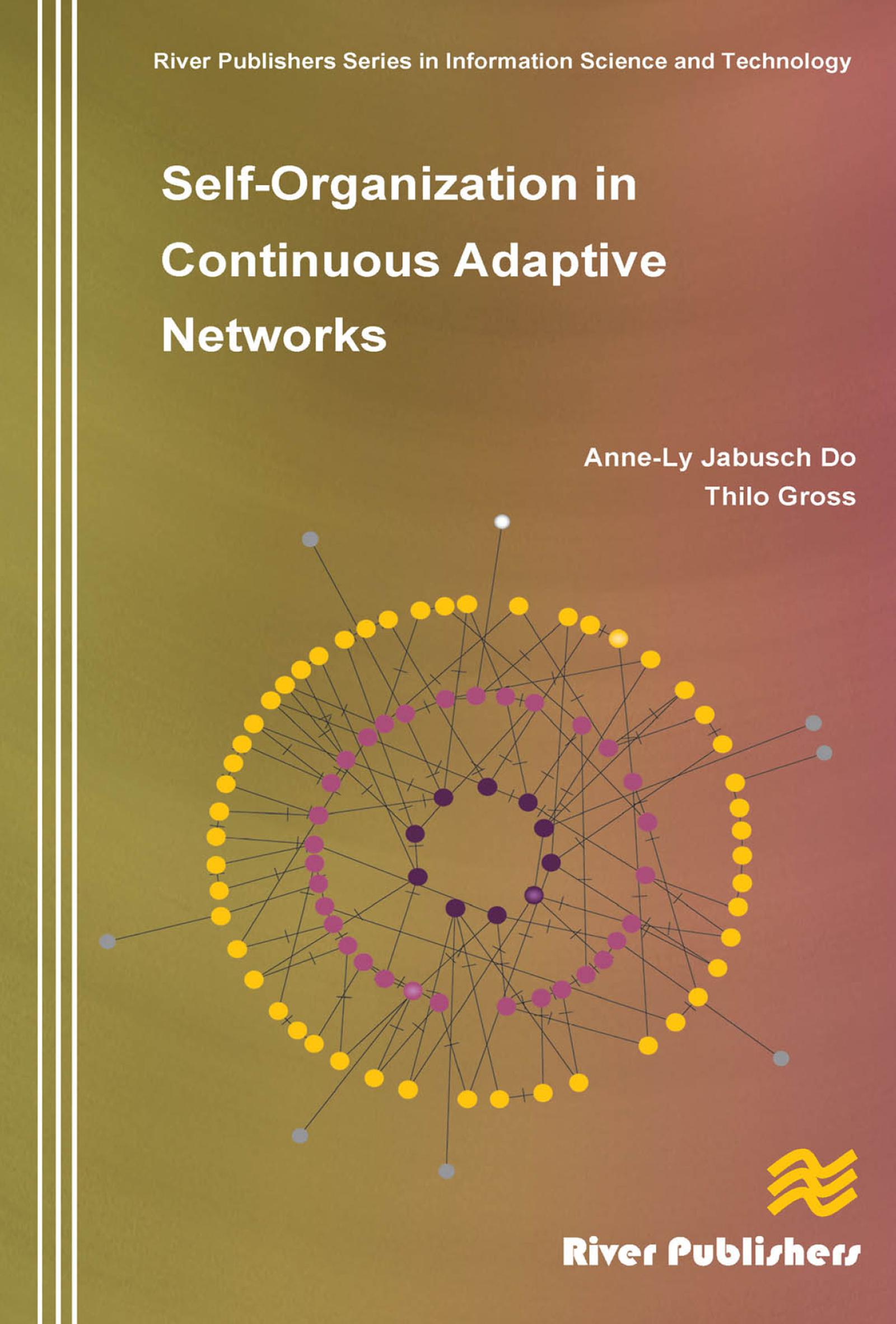
In the last years, adaptive networks have been discovered simultaneously in different fields as a universal framework for the study of self-organization phenomena. Understanding the mechanisms behind these phenomena is hoped to bring forward not only empirical disciplines such as biology, sociology, ecology, and economy, but also engineering disciplines seeking to employ controlled emergence in future technologies. This volume presents new analytical approaches, which combine tools from dynamical systems theory and statistical physics with tools from graph theory to address the principles behind adaptive self-organization. It is the first class of approaches that is applicable to continuous networks. The volume discusses the mechanisms behind three emergent phenomena that are prominently discussed in the context of biological and social sciences:• synchronization,• spontaneous diversification, and• self-organized criticality.Self-organization in continuous adaptive networks contains extended research papers. It can serve as both, a review of recent results on adaptive self-organization as well as a tutorial of new analytical methodsSelf-organization in continuous adaptive networks is ideal for academic staff and master/research students in complexity and network sciences, in engineering, physics and maths.
Betal nemt med kort, Klarna, Apple Pay eller Google Pay. Ikke tilfreds? Du har altid 14 dages fortrydelsesret. Læs mere i vores vilkår. Har du spørgsmål, så send os en mail på hello@memmo.org.
Memmo gør det nemmere at studere – uanset hvor du er i verden. Hos os samler du dine kursusbøger og smarte studieværktøjer ét sted: resuméer, quizzer, podcasts og flashcards. Og så er der Ted, din studieven, der svarer på alt, du undrer dig over. Over 50 000 studerende studerer allerede her – bygget til at hjælpe dig med at lære hurtigere og stresse mindre.
Du kan måske også lide
Køb bogen0