
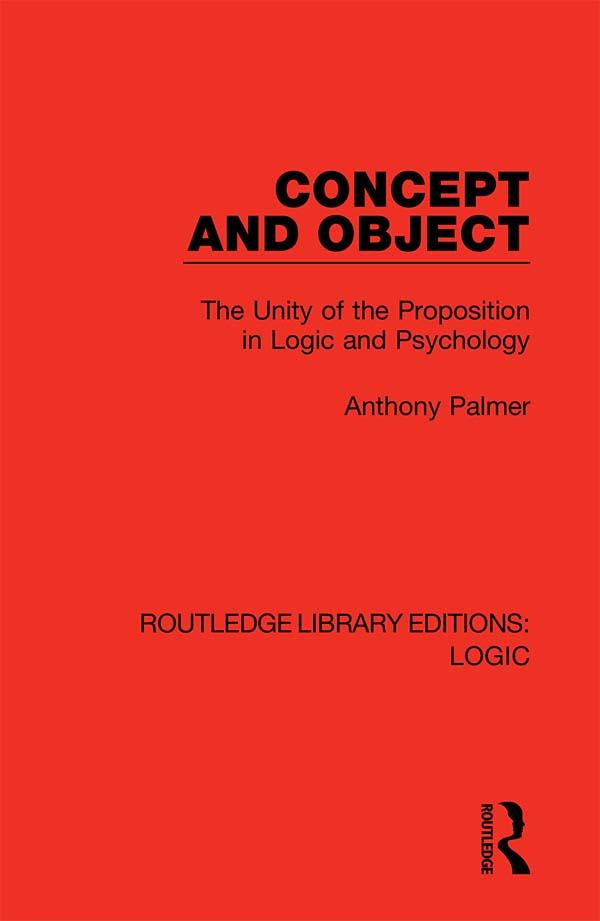
Originally published in 1988. This text gives a lucid account of the most distinctive and influential responses by twentieth century philosophers to the problem of the unity of the proposition. The problem first became central to twentieth-century philosophy as a result of the depsychoiogising of logic brought about by Bradley and Frege who, responding to the ’Psychologism’ of Mill and Hume, drew a sharp distinction between the province of psychology and the province of logic.
This author argues that while Russell, Ryle and Davidson, each in different ways, attempted a theoretical solution, Frege and Wittgenstein (both in the Tractatus and the Investigations) rightly maintained that no theoretical solution is possible. It is this which explains the importance Wittgenstein attached in his later work to the idea of agreement in judgments. The two final chapters illustrate the way in which a response to the problem affects the way in which we think about the nature of the mind. They contain a discussion of Strawson’s concept of a person and provide a striking critique of the philosophical claims made by devotees of artificial intelligence, in particular those made by Daniel Dennett.
Betal nemt med kort, Klarna, Apple Pay eller Google Pay. Ikke tilfreds? Du har altid 14 dages fortrydelsesret. Læs mere i vores vilkår. Har du spørgsmål, så send os en mail på hello@memmo.org.
Memmo gør det nemmere at studere – uanset hvor du er i verden. Hos os samler du dine kursusbøger og smarte studieværktøjer ét sted: resuméer, quizzer, podcasts og flashcards. Og så er der Ted, din studieven, der svarer på alt, du undrer dig over. Over 50 000 studerende studerer allerede her – bygget til at hjælpe dig med at lære hurtigere og stresse mindre.