
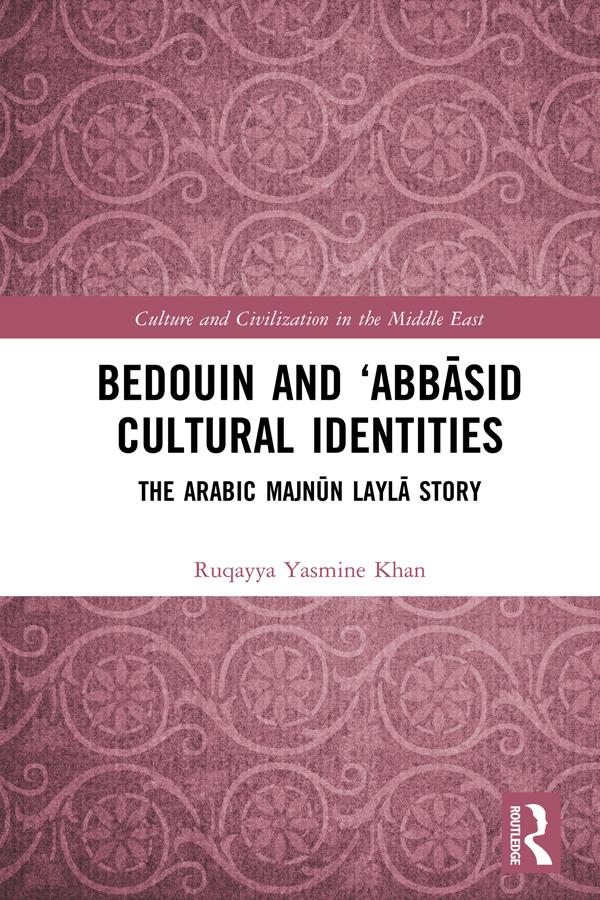
This literary-historical book draws out and sheds light upon the mechanisms of "the ideological work" that the Arabic Majnūn Laylā story performed for ‘Abbāsid urbanite, imperial audiences in the wake of the disappearance of the "Bedouin cosmos."
The study focuses upon the processes of primitivizing Majnūn in the romance of Majnūn Laylā as part of the paradigm shift that occurred in the ‘Abbāsid empire after the Greco-Arabian intellectual revolution. Moreover, this book demonstrates how gender and sexuality are employed in the processes of primitivizing Majnūn. As markers of "strangeness" and "foreignness" in the ‘Abbāsid interrogations of the multiple categories of ethnicity, culture, identity, religion and language present in their cosmopolitan milieus. Such "cultural work" is performed through the ideological uses of alterity given its mechanisms of distancing (e.g., temporal and spatial) and nearness (e.g., affective). Lastly, the Majnūn Laylā love story demonstrates, in its text and reception, that a Greco-Arabian and Greco-Persian subculture thrived in the centers of ‘Abbāsid Baghdad that molded and shaped the ways in which this love story was compiled, received and performed.
Offering a corrective to the prevailing views expressed in Western scholarly writings on the Greco-Arabian encounter, this book is a major contribution to scholars and students interested in Islamic studies, Arabic and comparative literature, Middle East and gender studies.
Betal nemt med kort, Klarna, Apple Pay eller Google Pay. Ikke tilfreds? Du har altid 14 dages fortrydelsesret. Læs mere i vores vilkår. Har du spørgsmål, så send os en mail på hello@memmo.org.
Memmo gør det nemmere at studere – uanset hvor du er i verden. Hos os samler du dine kursusbøger og smarte studieværktøjer ét sted: resuméer, quizzer, podcasts og flashcards. Og så er der Ted, din studieven, der svarer på alt, du undrer dig over. Over 50 000 studerende studerer allerede her – bygget til at hjælpe dig med at lære hurtigere og stresse mindre.