
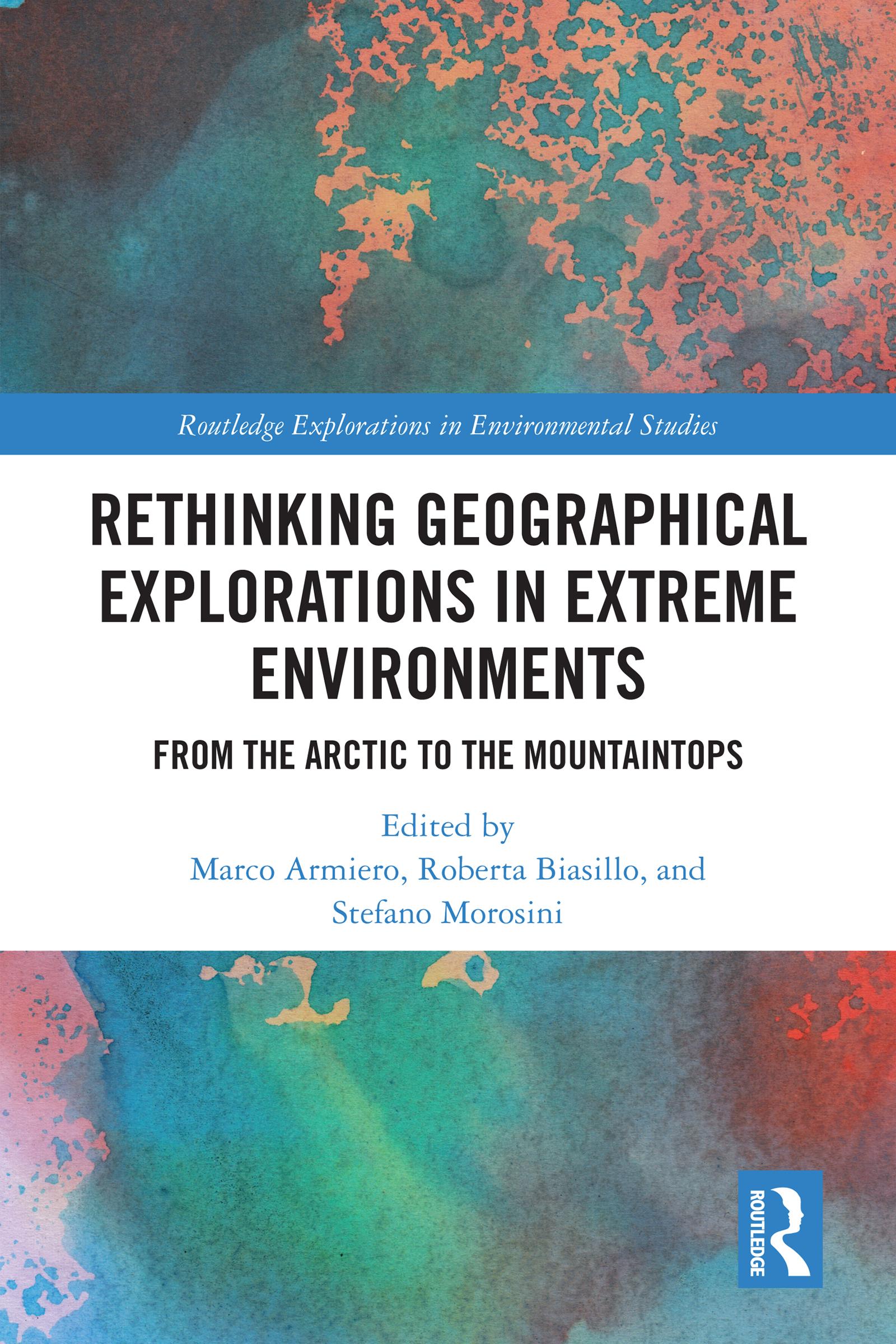
Focusing on extreme environments, from Umberto Nobile’s expedition to the Arctic to the commercialization of Mt Everest, this volume examines global environmental margins, how they are conceived and how perceptions have changed. Mountaintops and Arctic environments are the settings of social encounters, political strategies, individual enterprises, geopolitical tensions, decolonial practises, and scientific experiments.
Concentrating on mountaineering and Arctic exploration between 1880 – 1960, contributors to this volume show how environmental marginalisation has been discursively implemented and materially generated by foreign and local actors. It examines to what extent the status and identity of extreme environments has changed during modern times, moving them from periphery to the centre and discarding their marginality. The first section looks at ways in which societies have framed remoteness, through the lens of commercialization, colonialism, knowledge production and sport, while the second examines the reverse transfer, focusing on how extreme nature has influenced societies, through international network creation, political consensus and identity building. This collection enriches the historical understanding of exploration by adopting a critical approach and offering multidimensional and multi-gaze reconstructions.
This book is essential reading for students and scholars interested in environmental history, geography, colonial studies and the environmental humanities.
Betal nemt med kort, Klarna, Apple Pay eller Google Pay. Ikke tilfreds? Du har altid 14 dages fortrydelsesret. Læs mere i vores vilkår. Har du spørgsmål, så send os en mail på hello@memmo.org.
Memmo gør det nemmere at studere – uanset hvor du er i verden. Hos os samler du dine kursusbøger og smarte studieværktøjer ét sted: resuméer, quizzer, podcasts og flashcards. Og så er der Ted, din studieven, der svarer på alt, du undrer dig over. Over 50 000 studerende studerer allerede her – bygget til at hjælpe dig med at lære hurtigere og stresse mindre.