
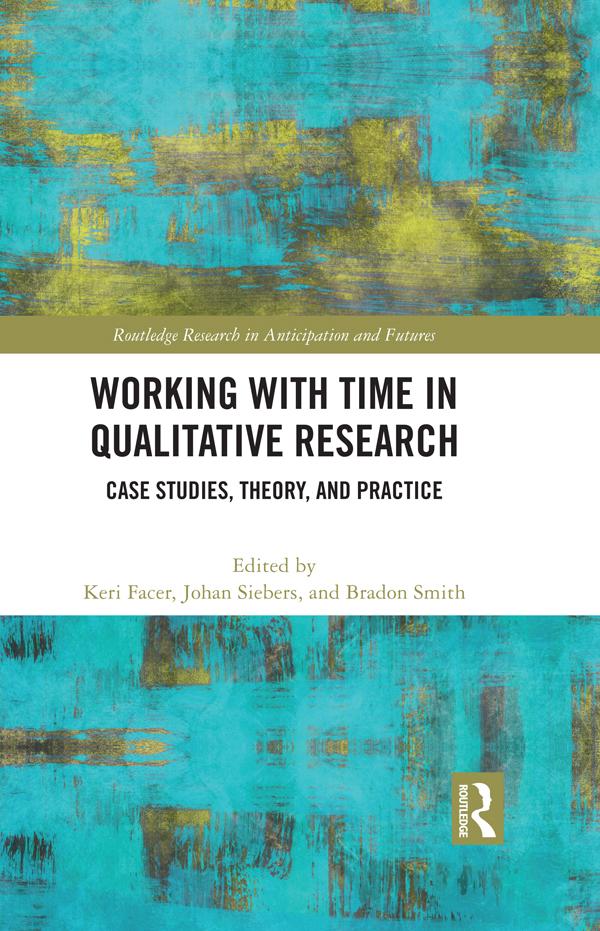
This collection brings together researchers and scholars from across the Arts, Humanities and Social Sciences who are actively exploring the many different ways in which time might be understood, imagined and used in qualitative research. Taken together, the contributions begin to trace the contours of what it might mean to work reflexively with time as an epistemologically constitutive element of research design.
The book explores how the choice to work with pasts or futures, with speed or delay, with clocks or the time of the body, with utopias or failed futures (among other things) reframe how social and cultural phenomena are perceived and brought into existence in qualitative research. Drawing on fields as disparate as futures studies and history, literary analysis and urban design, utopian studies and science and technology studies, this collection serves as a resource for both new and experienced researchers in the humanities and social sciences. It is a critically important resource for beginning to explore the wide repertoire of theoretical and methodological tools for working with time in the research process.
The book also draws attention to the way that institutional research timescapes – from university workload patterns to funding processes and project timescales – themselves shape how and what it is possible to know in and about the world. It concludes with a rousing manifesto for scholars and researchers, proposing 10 key attributes of temporally reflexive research.
Betal nemt med kort, Klarna, Apple Pay eller Google Pay. Ikke tilfreds? Du har altid 14 dages fortrydelsesret. Læs mere i vores vilkår. Har du spørgsmål, så send os en mail på hello@memmo.org.
Memmo gør det nemmere at studere – uanset hvor du er i verden. Hos os samler du dine kursusbøger og smarte studieværktøjer ét sted: resuméer, quizzer, podcasts og flashcards. Og så er der Ted, din studieven, der svarer på alt, du undrer dig over. Over 50 000 studerende studerer allerede her – bygget til at hjælpe dig med at lære hurtigere og stresse mindre.