
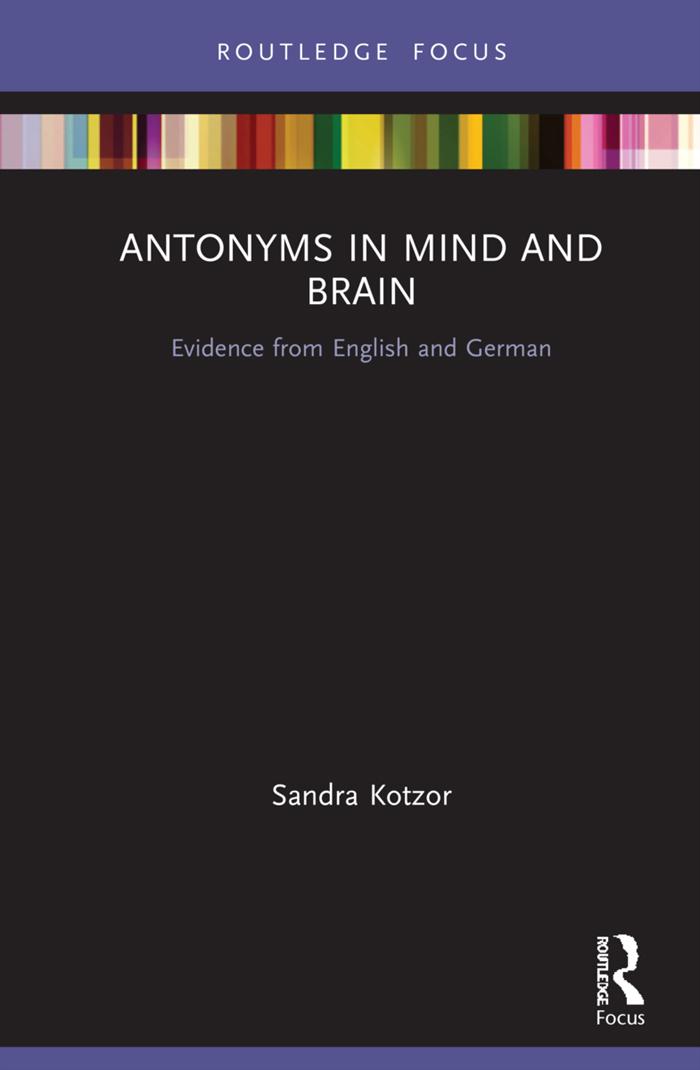
Antonyms in Mind and Brain presents a multi-method empirical investigation of opposition with a particular focus on the processing of opposite pairs and their representation in the mental lexicon. Building on recent cognitive accounts of antonymy which highlight the fundamentally conceptual nature of antonymy, this book
- outlines previous literature to draw out criteria for good opposites and establish the state of the art on the question whether the strong connection of certain opposite pairs is primarily of a conceptual or lexical nature.
- presents a detailed cross-linguistic empirical study combining corpus data, speaker judgements and behavioural experiments for a wide range of central (e.g. big:little) and peripheral (e.g. buy:sell; wife:husband) opposite pairs to establish the contribution of individual factors.
- proposes a model of the representation of opposite pairs in the mental lexicon and illustrates how the processing consequences of such a model account for the patterns observed in the data.
The approach taken in this book highlights the importance of using a number of different methods to investigate complex phenomena such as antonymy. Such an approach forms the empirical foundation for a dynamic psycholinguistic model of opposition based on the conventionalisation and entrenchment of the conceptual and lexical relationship of antonyms.
Betal nemt med kort, Klarna, Apple Pay eller Google Pay. Ikke tilfreds? Du har altid 14 dages fortrydelsesret. Læs mere i vores vilkår. Har du spørgsmål, så send os en mail på hello@memmo.org.
Memmo gør det nemmere at studere – uanset hvor du er i verden. Hos os samler du dine kursusbøger og smarte studieværktøjer ét sted: resuméer, quizzer, podcasts og flashcards. Og så er der Ted, din studieven, der svarer på alt, du undrer dig over. Over 50 000 studerende studerer allerede her – bygget til at hjælpe dig med at lære hurtigere og stresse mindre.