
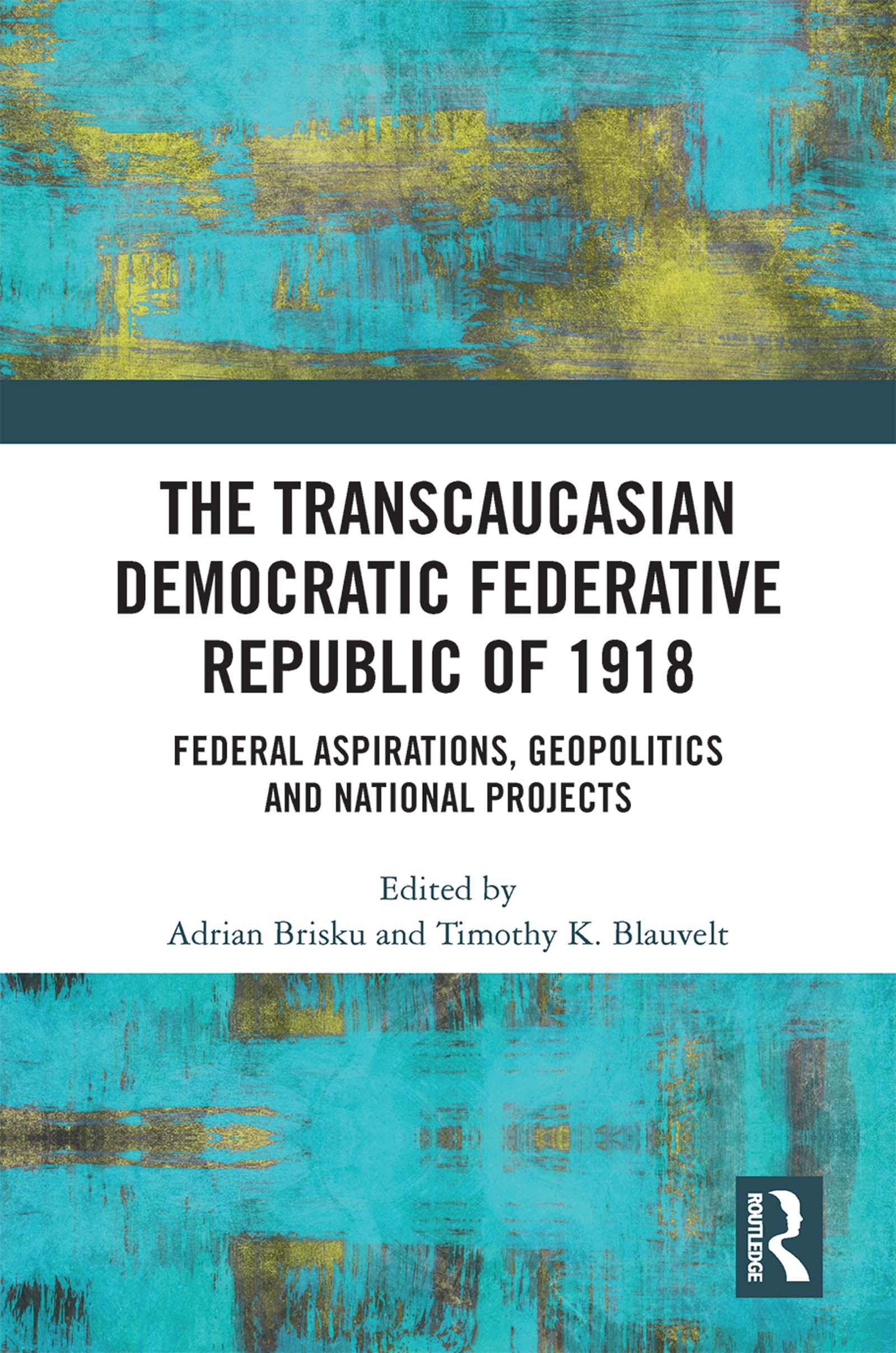
The Transcaucasian Democratic Federative Republic (TDFR) was a unique, bottom-up, and a fleeting display of political unity and federalism among the main Armenian, Azerbaijani and Georgian political factions between 22 April 1918, when it declared its independence, and 26 May 1918, when it was dissolved and replaced by the three nation-states of Armenia, Azerbaijan and Georgia. Focusing on a crucial but poorly understood moment in the modern history of the Caucasus at the end of the First World War, this book offers a systematic, contextually-rich, and multi-perspectival—Armenian, Azerbaijani, Georgian, Ottoman, German, British, American, Italian, Bolshevik, Ukrainian and North Caucasian—account of the TDFR, drawing on contributions (with the new material from archives in Tbilisi, Grozny, Yerevan, Baku, Istanbul, Berlin, London, Washington D.C.) by a new generation of historians and scholars working on the region.
The book argues that despite its month-long existence in this geopolitically volatile region, the TDFR, with and its federative nature and the various discussions about federalism and federation that it provoked, continued to have an appeal for Georgians, Azerbaijanis, Armenians as well as for the Great Powers well beyond its dissolution. Moreover, the experience of the TDFR reifies federalism as a key political concept in the modern history of the Caucasus.
The chapters in this book were originally published as a special issue of the Caucasus Survey.
Betal nemt med kort, Klarna, Apple Pay eller Google Pay. Ikke tilfreds? Du har altid 14 dages fortrydelsesret. Læs mere i vores vilkår. Har du spørgsmål, så send os en mail på hello@memmo.org.
Memmo gør det nemmere at studere – uanset hvor du er i verden. Hos os samler du dine kursusbøger og smarte studieværktøjer ét sted: resuméer, quizzer, podcasts og flashcards. Og så er der Ted, din studieven, der svarer på alt, du undrer dig over. Over 50 000 studerende studerer allerede her – bygget til at hjælpe dig med at lære hurtigere og stresse mindre.