
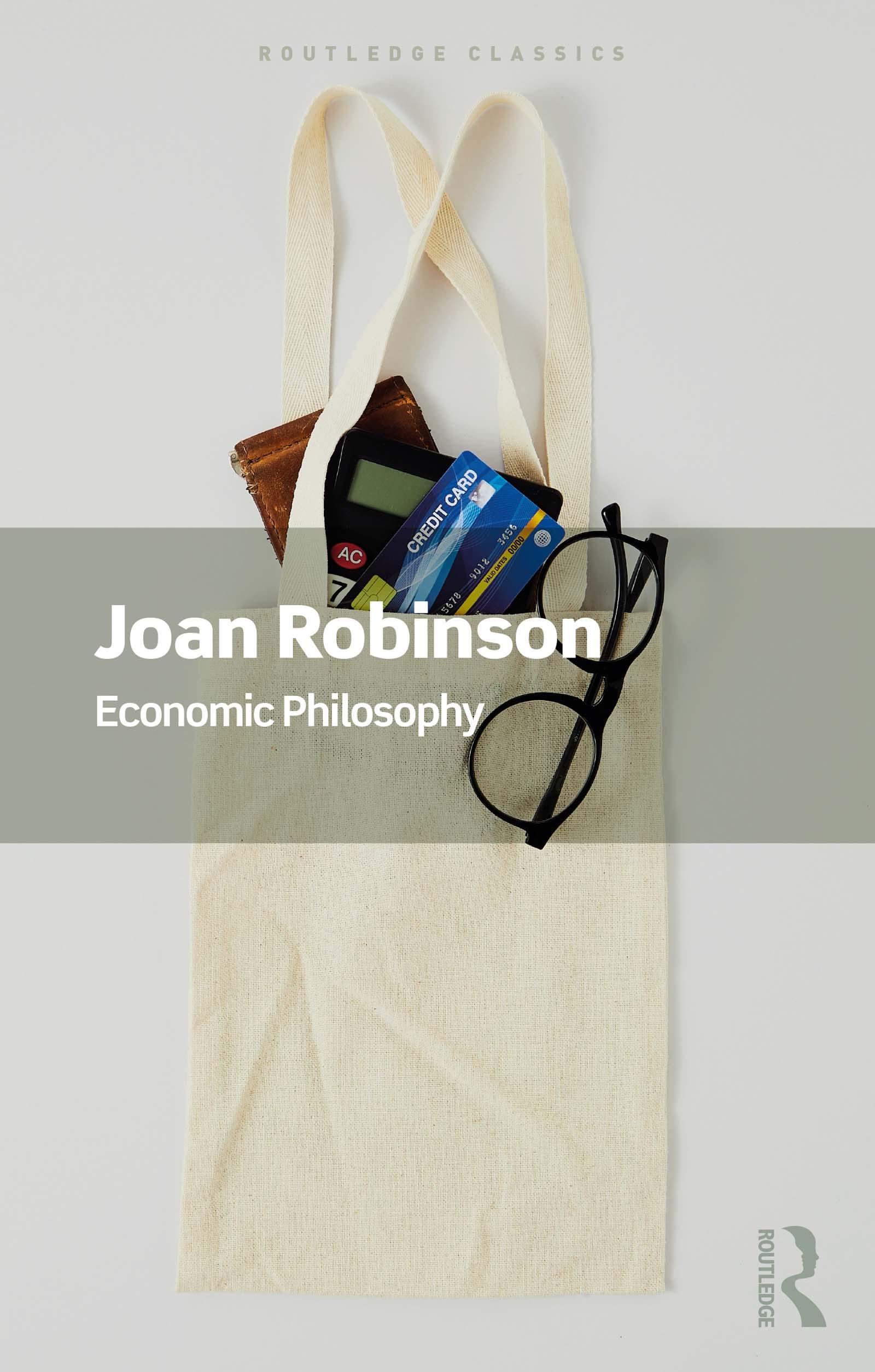
Joan Robinson (1903-1983) was one of the greatest economists of the twentieth century and a fearless critic of free-market capitalism. A major figure in the controversial ‘Cambridge School’ of economics in the post-war period, she made fundamental contributions to the economics of international trade and development.
In Economic Philosophy Robinson looks behind the curtain of economics to reveal a constant battle between economics as a science and economics as ideology, which she argued was integral to economics. In her customary vivid and pellucid style, she criticizes early economists Adam Smith and David Ricardo, and neo-classical economists Alfred Marshall, Stanley Jevons and Leon Walras, over the question of value. She shows that what they respectively considered to be the generators of value - labour-time, marginal utility or preferences - are not scientific but ‘metaphysical’, and that it is frequently in ideology, not science, that we find the reason for the rejection of economic theories. She also weighs up the implications of the Keynesian revolution in economics, particularly whether Keynes’s theories are applicable to developing economies. Robinson concludes with a prophetic lesson that resonates in today’s turbulent and unequal economy: that the task of the economist is to combat the idea that the only values that count are those that can be measured in terms of money.
This Routledge Classics edition includes a new foreword by Sheila Dow.
Betal nemt med kort, Klarna, Apple Pay eller Google Pay. Ikke tilfreds? Du har altid 14 dages fortrydelsesret. Læs mere i vores vilkår. Har du spørgsmål, så send os en mail på hello@memmo.org.
Memmo gør det nemmere at studere – uanset hvor du er i verden. Hos os samler du dine kursusbøger og smarte studieværktøjer ét sted: resuméer, quizzer, podcasts og flashcards. Og så er der Ted, din studieven, der svarer på alt, du undrer dig over. Over 50 000 studerende studerer allerede her – bygget til at hjælpe dig med at lære hurtigere og stresse mindre.