
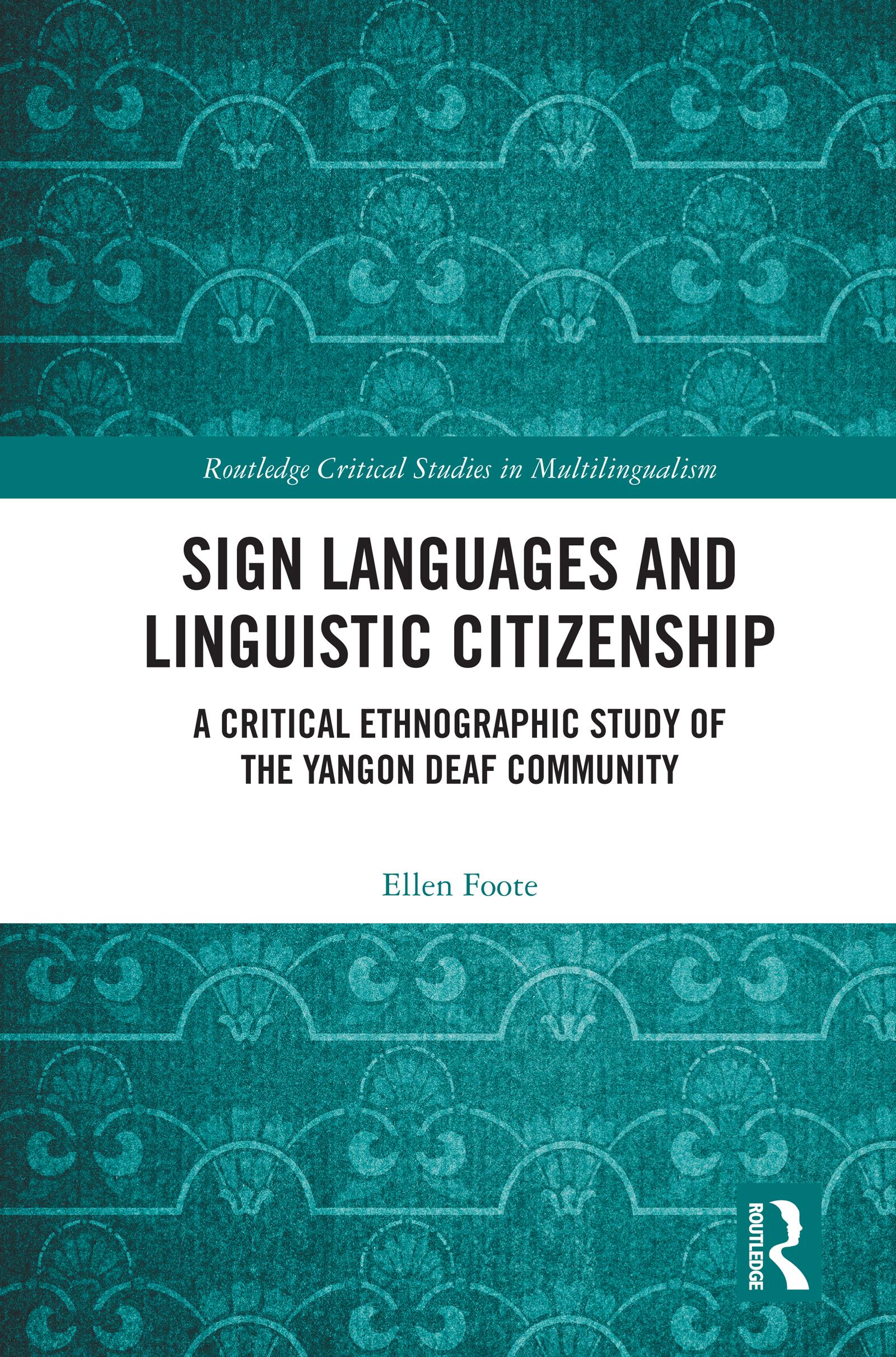
This critical ethnographic account of the Yangon deaf community in Myanmar offers unique insights into the dynamics of a vibrant linguistic and cultural minority community in the region and also sheds further light on broader questions around language policy.
The book examines language policies on different scales, demonstrating how unofficial policies in the local deaf school and wider Yangon deaf community impact responses to higher level interventions, namely the 2007 government policy aimed at unifying the country’s two sign languages. Foote highlights the need for a critical and interdisciplinary approach to the study of language policy, unpacking the interplay between language ideologies, power relations, political and moral interests and community conceptualisations of citizenship. The study’s findings are situated within wider theoretical debates within linguistic anthropology, questioning existing paradigms on the notion of linguistic authenticity and contributing to ongoing debates on the relationship between language policy and social justice.
Offering an important new contribution to critical work on language policy, the book will be of particular interest to students and scholars in sociolinguistics, linguistic anthropology and language education.
Betal nemt med kort, Klarna, Apple Pay eller Google Pay. Ikke tilfreds? Du har altid 14 dages fortrydelsesret. Læs mere i vores vilkår. Har du spørgsmål, så send os en mail på hello@memmo.org.
Memmo gør det nemmere at studere – uanset hvor du er i verden. Hos os samler du dine kursusbøger og smarte studieværktøjer ét sted: resuméer, quizzer, podcasts og flashcards. Og så er der Ted, din studieven, der svarer på alt, du undrer dig over. Over 50 000 studerende studerer allerede her – bygget til at hjælpe dig med at lære hurtigere og stresse mindre.