
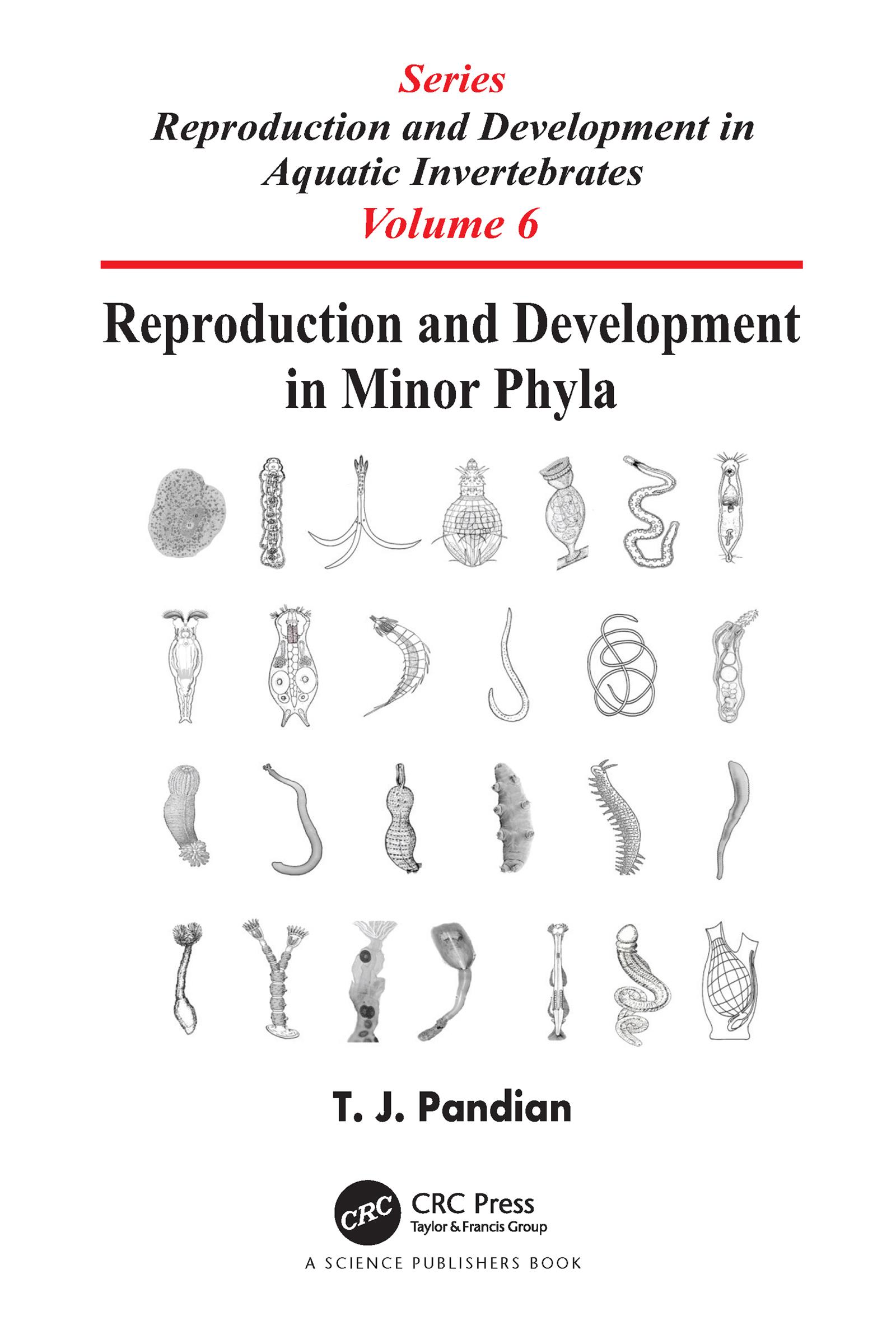
The 26 recognized minor phyla comprise aberrant clades, as most of them terminate as blind offshoots. Untied from the discussion on their phylogenesis of minor phyla, this book is largely devoted, for the first time, to aspects of reproduction and development in minor phyletics. The minor phyla are not as speciose (1,795 species/phylum) as the major phyla (157,066 species/phylum) are. The accumulation of deleterious genes causes inbreeding depression among progenies arising from parthenogenesis, clonal multiplication and selfing hermaphrodites. The reason for the limited species diversity in minor phyla is traced to (i) eutelism in 65.7% of minor phyletics and (ii) existence of 21.6% clonals, (iii) 6.4% parthenogens and (iv) 1.2% selfing hermaphroditism. Gonochorism obligately requires motility to search for a mate. The combination of low motility and gonochorism from Placozoa to hemocoelomatic minor phyla has limited diversity to < 1,000 species. Over 19% of minor phyletics are hermaphrodites. With the need to manifest and maintain dual sexuality, fecundity of hermaphrodites may be reduced to 50% of that in gonochores. Adopting an array of strategies, < 100 hermaphrodites are selfers. In eutelics, mitotic division is ceased in somatic cells after hatching. For the first time, the prevalence of eutelism has been brought to light in numbers of all the six pseudocoelomate phyla and priapulids. Eutelism limits fecundity to 30–300 eggs in free-living pseudocoelomates, priapulids and possibly other hemocoelomates. In them, sperm production is less than that of egg production; as a result, a large fraction of their eggs is sterile. With a high proportion of non-eutelic gametic cells (35%), Nematoda and possibly Nematomorpha and Acanthocephala are more fecund than rotifers, in which the proportion is 15%. Briefly, the reasons for the limited species diversity in minor phyletics are traced to eutelism, parthenogenesis and clonal multiplication. Surprisingly, parthenogenesis and clonal multiplication mutually eliminate each other. This is also true of hermaphroditism and parthenogenesis. However, clonal multiplication is prevalent from structurally simplest Placozoa to the most complex Ascidiacea, except in pseudocoelomates and hemocoelomates. A limited number of cells and cell types, and the consequent structural simplicity facilitate manifestation of parthenogenesis in pseudocoelomates and parasitism in Mesozoa, Myxozoa, 59% of Nematoda, Nematomorpha, Acanthocephala and Pentastomida. Despite hermaphroditism, Bryozoa (5,700 species) and Ascidiacea (3,000 species) are speciose among minor phyla. For the first time, the importance of fusion of fragments or colonies – an event equivalent to gamete fusion at fertilization – is recognized as a source of new gene combination. Besides, the colonies in these minor phyla degenerate and regenerate more or less regularly. Only the fittest degenerated colonies may be rejuvenated and regenerated.
Betal nemt med kort, Klarna, Apple Pay eller Google Pay. Ikke tilfreds? Du har altid 14 dages fortrydelsesret. Læs mere i vores vilkår. Har du spørgsmål, så send os en mail på hello@memmo.org.
Memmo gør det nemmere at studere – uanset hvor du er i verden. Hos os samler du dine kursusbøger og smarte studieværktøjer ét sted: resuméer, quizzer, podcasts og flashcards. Og så er der Ted, din studieven, der svarer på alt, du undrer dig over. Over 50 000 studerende studerer allerede her – bygget til at hjælpe dig med at lære hurtigere og stresse mindre.