
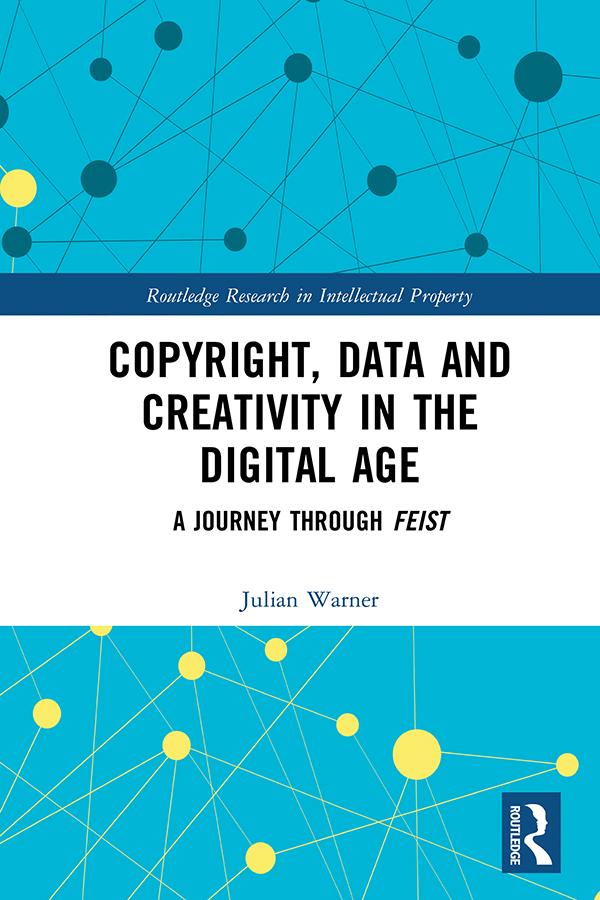
The Supreme Court of the United States in Feist v. Rural (1991) required that databases must have a minimal degree of creativity for copyright. The judgment was highly significant and the subsequent period is understood as the post-Feist era. It has been globally influential. However, the decision is extremely complex and remains unsatisfactorily interpreted. In particular, it has been impossible to illuminate the creativity requirement.
The book gives an account of the decision’s conceptual structure, focusing on its full delineation of the opposite to creativity. In a radical and unprecedented innovation, it is correlated with an automatic computational process. Creativity itself is understood as non-computational or directly human activity concerned with meaning. Determining the presence of creativity is reduced to a four-stage test. This work then has acute practical current relevance to property in data in the digital age; it will also be of theoretical interest to, and is aimed at, researchers in, practitioners, and students of intellectual property worldwide.
Betal nemt med kort, Klarna, Apple Pay eller Google Pay. Ikke tilfreds? Du har altid 14 dages fortrydelsesret. Læs mere i vores vilkår. Har du spørgsmål, så send os en mail på hello@memmo.org.
Memmo gør det nemmere at studere – uanset hvor du er i verden. Hos os samler du dine kursusbøger og smarte studieværktøjer ét sted: resuméer, quizzer, podcasts og flashcards. Og så er der Ted, din studieven, der svarer på alt, du undrer dig over. Over 50 000 studerende studerer allerede her – bygget til at hjælpe dig med at lære hurtigere og stresse mindre.