
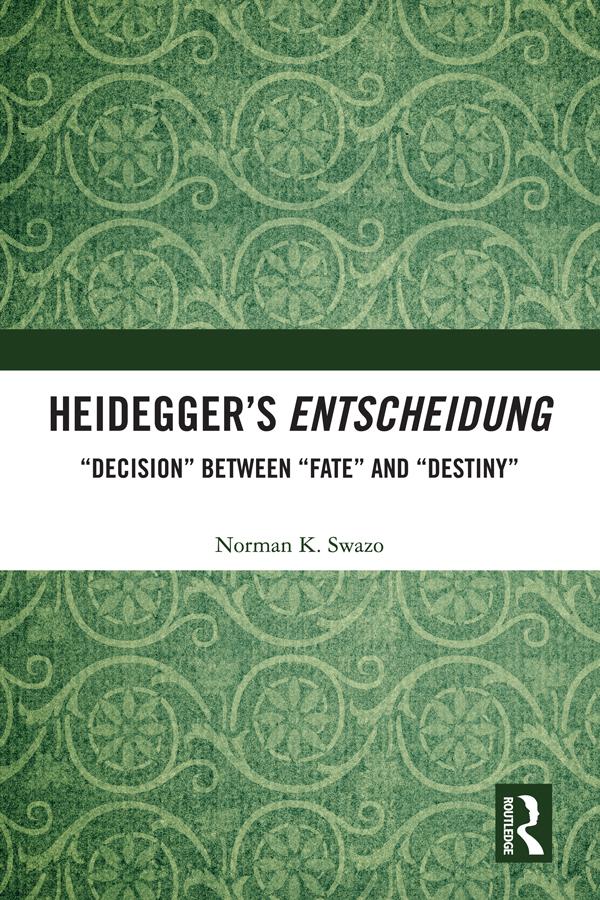
This book critically examines the debate on Martin Heidegger’s concept of Entscheidung ("decision") and his engagement and confrontation with Nazism in terms of his broader philosophical thought. It argues that one cannot explain Heidegger’s actions without accounting for his idea of "decision" and its connection to his understanding of individual "fate" and national (and European) "destiny." The book looks at the relation of biography to philosophy and the ethical and political implications of appropriating Heidegger’s thinking in these domains of inquiry. It highlights themes such as Heidegger’s differences with the neo-Kantians in Germany; Heidegger on Kant and practical reason; and his reading of Nietzsche and Hegel. It offers a philosophical assessment grounded in Heidegger’s own texts, with reference to historical and other philosophical commentaries on the rise of National Socialism in post-Weimar Germany and the philosophical issues associated with the interpretation of Nazi genocide and ideology.
An important intervention in Western philosophy, this book will be of great interest to scholars and researchers of political philosophy, continental philosophy, German philosophy, philosophy in general, and political studies.
Betal nemt med kort, Klarna, Apple Pay eller Google Pay. Ikke tilfreds? Du har altid 14 dages fortrydelsesret. Læs mere i vores vilkår. Har du spørgsmål, så send os en mail på hello@memmo.org.
Memmo gør det nemmere at studere – uanset hvor du er i verden. Hos os samler du dine kursusbøger og smarte studieværktøjer ét sted: resuméer, quizzer, podcasts og flashcards. Og så er der Ted, din studieven, der svarer på alt, du undrer dig over. Over 50 000 studerende studerer allerede her – bygget til at hjælpe dig med at lære hurtigere og stresse mindre.