
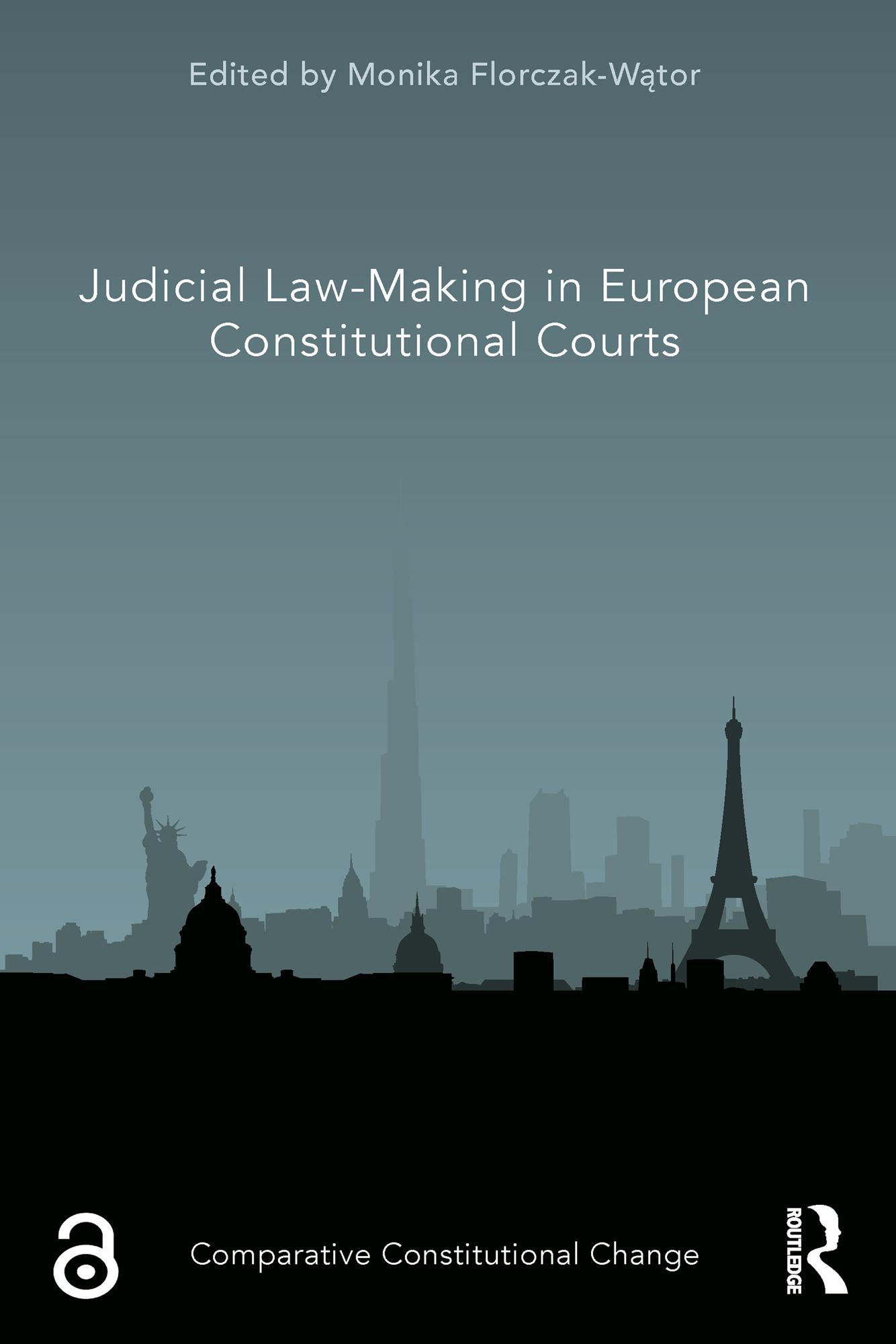
This book analyses the specificity of the law-making activity of European constitutional courts. The main hypothesis is that currently constitutional courts are positive legislators whose position in the system of State organs needs to be redefined.
The book covers the analysis of the law-making activity of four constitutional courts in Western countries: Germany, Italy, Spain, and France; and six constitutional courts in Central–East European countries: Poland, Hungary, the Czech Republic, Slovak Republic, Latvia, and Bulgaria; as well as two international courts: the European Court of Human Rights (ECtHR) and the Court of Justice of the European Union (CJEU). The work thus identifies the mutual interactions between national constitutional courts and international tribunals in terms of their law-making activity. The chosen countries include constitutional courts which have been recently captured by populist governments and subordinated to political powers. Therefore, one of the purposes of the book is to identify the change in the law-making activity of those courts and to compare it with the activity of constitutional courts from countries in which democracy is not viewed as being under threat. Written by national experts, each chapter addresses a series of set questions allowing accessible and meaningful comparison.
The book will be a valuable resource for students, academics, and policy-makers working in the areas of constitutional law and politics.
Betal nemt med kort, Klarna, Apple Pay eller Google Pay. Ikke tilfreds? Du har altid 14 dages fortrydelsesret. Læs mere i vores vilkår. Har du spørgsmål, så send os en mail på hello@memmo.org.
Memmo gør det nemmere at studere – uanset hvor du er i verden. Hos os samler du dine kursusbøger og smarte studieværktøjer ét sted: resuméer, quizzer, podcasts og flashcards. Og så er der Ted, din studieven, der svarer på alt, du undrer dig over. Over 50 000 studerende studerer allerede her – bygget til at hjælpe dig med at lære hurtigere og stresse mindre.