
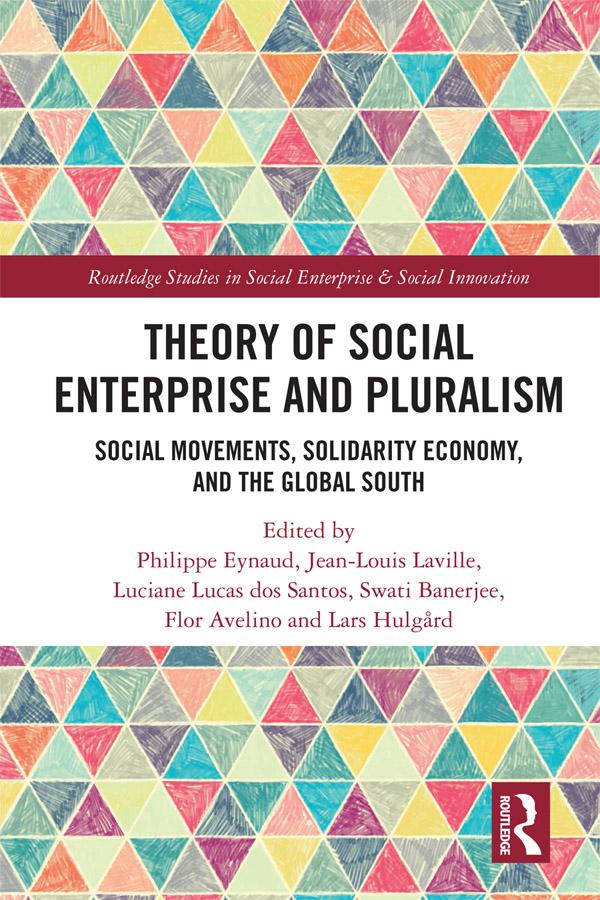
In the past decades, social enterprise has been an emerging field of research. Its main frameworks have been provided by Occidental approaches. Mainly based on an organizational vision, they give little or no room to questions such as gender, race, colonialism, class, power relations and intertwined forms of inequality. However, a wide range of worldwide hidden, popular initiatives can be considered as another form of social enterprises based on solidarity, re-embedding the economy as well as broadening the political scope. This has been shown in a previous book: Civil Society, the Third Sector, and Social Enterprise: Governance and Democracy.
Thus, to be more than a fashion or a fictitious panacea, the concept of social enterprise needs to be debated. Southern realities cannot be only understood through imported categories and outside modeled guidelines. This book engages a multicontinental and pluridisciplinary discussion in order to provide a pluralist theory of social enterprise. The book will be of interest to researchers, academics and students in the fields of social entrepreneurship, social innovation, development studies, management studies and social work.
Betal nemt med kort, Klarna, Apple Pay eller Google Pay. Ikke tilfreds? Du har altid 14 dages fortrydelsesret. Læs mere i vores vilkår. Har du spørgsmål, så send os en mail på hello@memmo.org.
Memmo gør det nemmere at studere – uanset hvor du er i verden. Hos os samler du dine kursusbøger og smarte studieværktøjer ét sted: resuméer, quizzer, podcasts og flashcards. Og så er der Ted, din studieven, der svarer på alt, du undrer dig over. Over 50 000 studerende studerer allerede her – bygget til at hjælpe dig med at lære hurtigere og stresse mindre.