
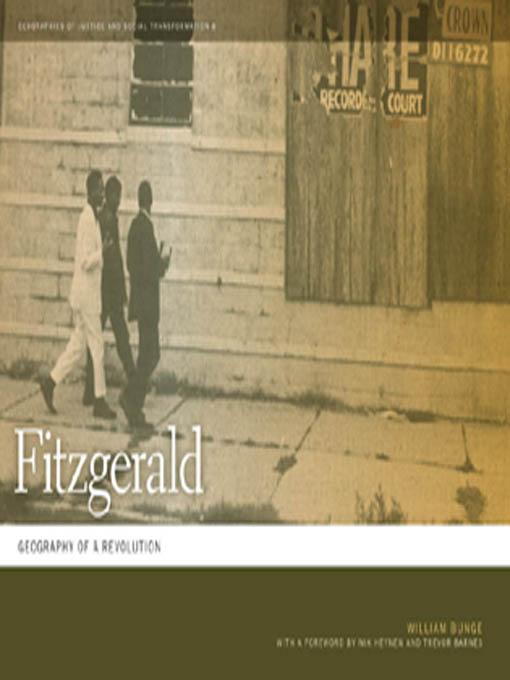
This on-the-ground study of one square mile in Detroit was written in collaboration with neighborhood residents, many of whom were involved with the famous Detroit Geographical Expedition and Institute. Fitzgerald, at its core, is dedicated to understanding global phenomena through the intensive study of a small, local place.
Beginning with an 1816 encounter between the Ojibwa population and the neighborhood’s first surveyor, William Bunge examines the racialized imposition of local landscapes over the course of European American settlement. Historical events are firmly situated in space—a task Bunge accomplishes through liberal use of maps and frequent references to recognizable twentieth-century landmarks.
More than a work of historical geography, Fitzgerald is a political intervention. By 1967 the neighborhood was mostly African American; Black Power was ascendant; and Detroit would experience a major riot. Immersed in the daily life of the area, Bunge encouraged residents to tell their stories and to think about local politics in spatial terms. His desire to undertake a different sort of geography led him to create a work that was nothing like a typical work of social science. The jumble of text, maps, and images makes it a particularly urgent book—a major theoretical contribution to urban geography that is also a startling evocation of street-level Detroit during a turbulent era.
A Sarah Mills Hodge Fund Publication
Betal nemt med kort, Klarna, Apple Pay eller Google Pay. Ikke tilfreds? Du har altid 14 dages fortrydelsesret. Læs mere i vores vilkår. Har du spørgsmål, så send os en mail på hello@memmo.org.
Memmo gør det nemmere at studere – uanset hvor du er i verden. Hos os samler du dine kursusbøger og smarte studieværktøjer ét sted: resuméer, quizzer, podcasts og flashcards. Og så er der Ted, din studieven, der svarer på alt, du undrer dig over. Over 50 000 studerende studerer allerede her – bygget til at hjælpe dig med at lære hurtigere og stresse mindre.